Let’s be very clear, the R & A and USGA do fantastic work in all areas of golf. The US Open at Shinnecock Hills was spectacular. The Open Championship at Royal Birkdale was a triumph. The AIG Women’s Open Championship at Royal Lytham & St Anne’s showcased top notch women’s golf and a fabulous course. The amateur events run by The R & A and USGA are amazing. There is so much great stuff.
But I’m afraid there may be some imperfections! It might be argued that there are “a few things The R & A and USGA get wrong”.
I’ve previously written about my concerns about WHS and the likely (certain?) failure of the future “golf ball roll-back”.
You can read my thoughts on these topics at the following links.
The Rules of Golf are of necessity quite complex as they need to cover a wide range of circumstances.
The Rules were once straightforward. There were just 13. They were drawn up in 1744 in Edinburgh for the world’s first ‘open’ golf competition at Leith by the Gentlemen Golfers of Edinburgh.
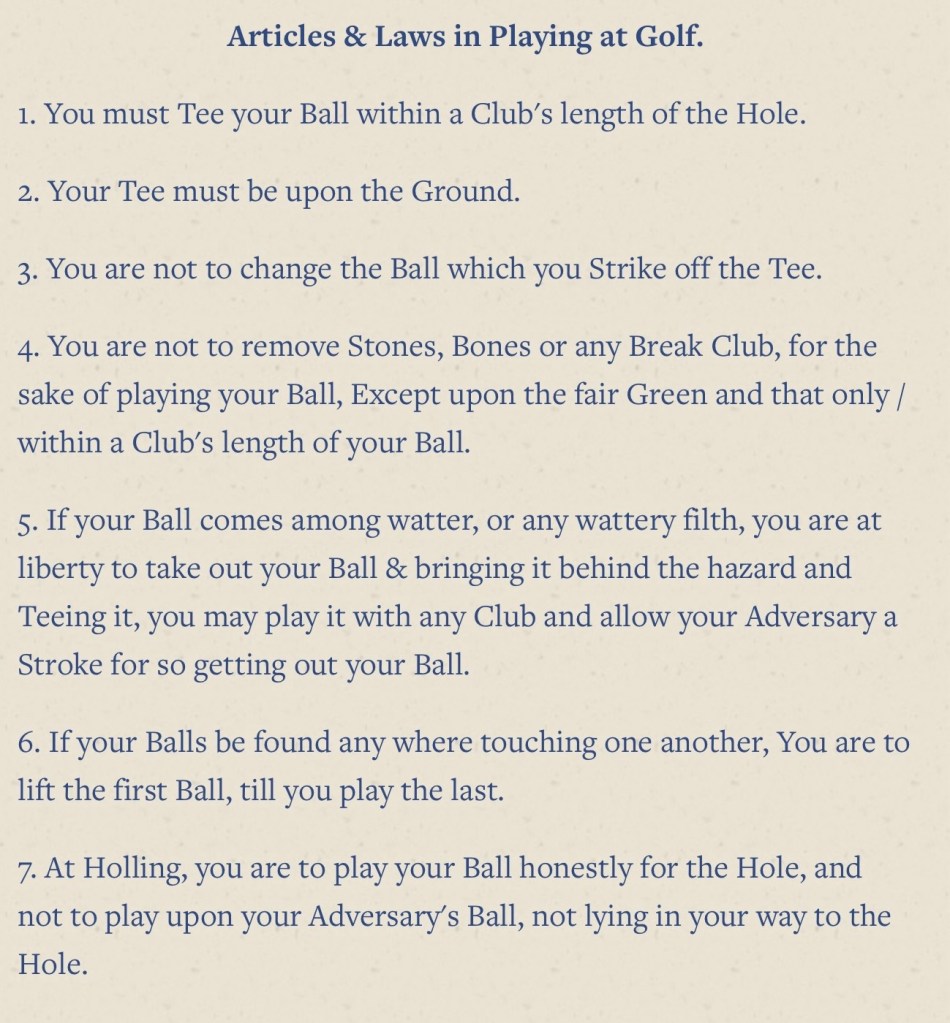

Now they are not so simple!
So I want to turn my attention to some rules issues I have some concerns about. I should like to thank Francis, David and Brian with whom I played last week on our annual group trip to the West of Ireland and Enniscrone. They made some really valuable suggestions that I have incorporated here.
There are many things one could discuss but here I’ll focus on issues on the putting green.
Nonsense on the putting green
Let’s consider four issues from on, and around, the putting surfaces that warrant discussion.
1: Marking the ball on the green: do it once – and only once!
Television coverage of professional golf often reveals some very slow play. Recently, we saw Matt Fitzpatrick mark his ball. He then lifted the ball, cleaned it and then replace it at the marker: all perfectly permissible within the current rules. With the marker still down he tweaked its alignment multiple times. He stepped back: crouched down and peared down the line. He returned to the still marked ball and again re-aligned it multiple times. It took ages, yet was all within the rules. I use the example of Fitzpatrick (who is generally not a slow player) merely because I recall his actions vividly – but he is not alone in this time wasting behaviour.
Now when on the fairway, for example under conditions when “lift, clean and place” are in play (usually referred to as “preferred lies”), you can lift, clean the ball and place the ball: but once and only once . . . and then the ball is in play.
The relevant rule on the fairway is Rule 14.2 – Placing a Ball, together with the Model Local Rule E-3 (Preferred Lies). Once you place the ball it is in play. No more tweaking!
- Rule 14.2 sets out the general procedure for placing a ball in the general area (but not the green). When a rule requires or allows you to place a ball:
- You must mark the ball’s original spot before lifting it.
- You may clean the ball.
- You must place it on the required spot (or within the permitted relief area if a Local Rule allows that).
- Once the ball has been placed and comes to rest on that spot, it is in play.
- Model Local Rule E-3 (Preferred Lies) is the Local Rule that committees adopt when they want to allow “winter rules” or “preferred lies.” It specifies:
- The ball must lie in a part of the general area cut to fairway height or less (unless the Local Rule says otherwise).
- The player may mark, lift, clean and place the ball.
- The ball must be placed within the distance specified by the Committee (commonly 6 inches, one scorecard length, or another stated distance), not nearer the hole.
- The player may lift and place the ball only once. After it has been placed and is in play, if the player lifts it again without another rule permitting it, the player incurs a penalty.
Fitzpatrick’s multiple placing and tweaking and re-tweaking took seemingly forever. Amateurs watching that performance will copy it and this contributes to interminably slow play. Let’s stop this nonsense. I would argue that the same stricture should apply on the green (and I know that Brian, Francis and David agree – maybe others do as well?).
No more time consuming tweaking.
Come on R & A and the USGA – make the placing of the ball on the green the same as on the fairway (and elsewhere in the general area) – Rule 14.2 should apply everywhere: place the ball once (and only once) and the ball is in play.
2: The pin in, pin out hokey kokey
Watch a group of golfers on the putting green and you frequently see a sort of golfing hokey cokey: a tedious dance with players and the flagstick (the pin):
Put the pin in,
Pull the pin out,
In, out, in, out,
Shake it all about……
What was once a matter of etiquette and routine has become a question of preference.
In the revisions to the Rules of Golf that came into effect in January 2019, and in an effort (it is said) to speed up play the rules were changed to allow putting to occur on the green with either the pin out or the pin in. Before this a putt from on the green that struck the pin incurred a penalty for the player who struck the putt.
Under the old (pre-2019) Rule 17-3, a player couldn’t make a stroke from the putting green if the unattended flagstick was still in the hole, since if the ball subsequently struck the flagstick, the player incurred the general penalty, which in Match play was loss of the hole, and in Stroke play a two stroke penalty.
Now you can leave the pin in and if the ball strikes it there is no penalty, or you can take the pin out. All fine. So what’s the problem? Well the problem is that some players insist on having the pin in and some are absolutely wedded to the pin being out. Some want it in all the time or out all the time, while others change their minds at seemingly a whim or perhaps they like it in for long putts and out for short putts. Whatever is preferred, so we have moved from a situation where there was absolute clarity to one where there is no clarity and often great confusion. What there certainly is, is delay and yet another contributor to slow play!
This was predictable and the R & A and the USGA should have trialled this rule change and considered the impact on pace of play before they made such a change.
Come on R & A and the USGA – revert to the original clear and straightforward rule and help us speed up play!
3: The putter should be the shortest club in the bag and anchoring should be banned.
The Open at Royal Portrush in July 2026 was huge for Northern Ireland. It was going to be incredibly busy so Hilary and I decided to watch the Championship on TV. However, to get a feel for the course (that we know well) and the atmosphere we went on the final practice day. It so happened that we followed for most of the front nine a young German golfer, Matti Schmid.
It was great to watch such a talent in a relatively relaxed setting. One thing we noticed was his careful putting drills from all quadrants of the green. Now Schmid uses a perfectly legal broom handled (that is a long) putter. His left hand is at the top and is close to his sternum. It’s essentially non-moving and acts as a fulcrum for the pendulum motion of the putter.
Over several hours and watching from many different angles I simply could not tell whether the putter and his left hand were anchored (that is touching his chest). They were certainly touching his shirt, but anchored? I couldn’t tell. Now not for a moment am I suggesting any rule breaking on this player’s part. But what I will say is that watching carefully I just couldn’t tell.
I’m not the only person to see this. Iain Carter, formerly of the BBC, has commented on this recently and other players seem to have putting actions where anchoring may (and I emphasise “may”) be happening.
The rule is allegedly quite clear. Rule 10.1 of the Rules of Golf states:
“When making a stroke, a player must not anchor the club” by “doing it ‘directly’, by holding the club or a ‘gripping hand’ against any part of the body”.
“If the player’s club, gripping hand or forearm merely touches their body or clothing during the stroke, without being held against the body, there is no breach of this rule.”
It’s as clear as mud! How can you tell?
Now Adam Scott uses a long putter but watching him on TV you can always see his upper hand is obviously clear of his body and shirt. I think the situation there is very clear.

In contrast, look at this image of Matti Schmid. As with watching him “live” at Royal Portrush I can’t tell if he’s anchoring or not. It’s just not possible to be sure. I’m not making any accusations! I’m merely saying it’s neither obvious nor clear.

If one cannot be sure about anchoring how can the rule be implemented fairly, consistently and objectively? The answer is simple: it can’t!
The rule is fundamentally flawed!
We can go a step further having the putter shaft firmly along the arm is not deemed anchoring: it is legal – perfectly acceptable. Look at these pictures of Bryson DeChambeau and Will Zalatoris putting perfectly legally. The putter shafts are firmly locked to the left arms: what is this if it is not anchoring?
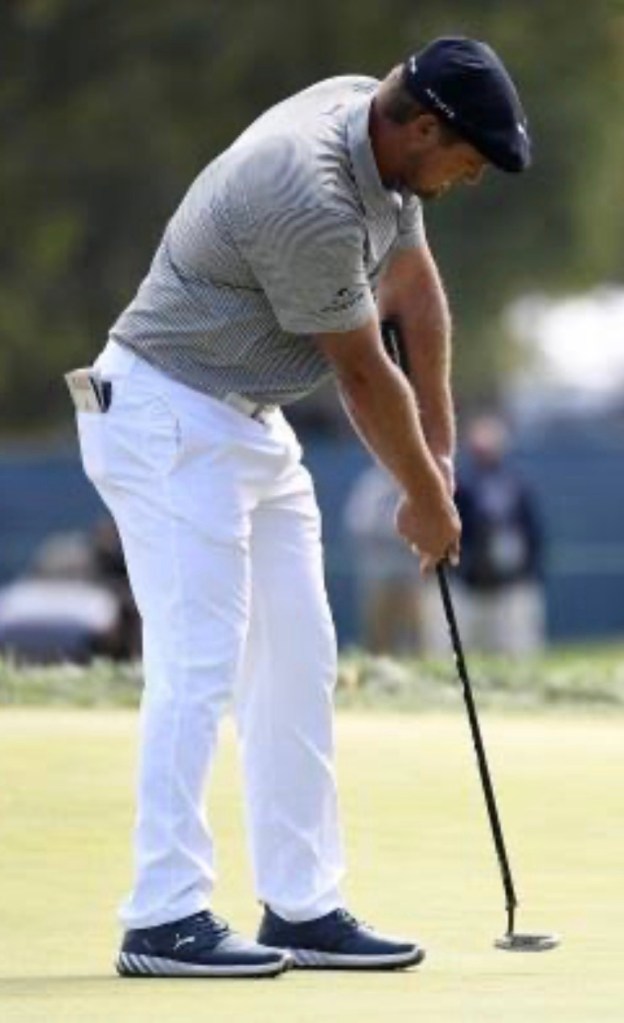
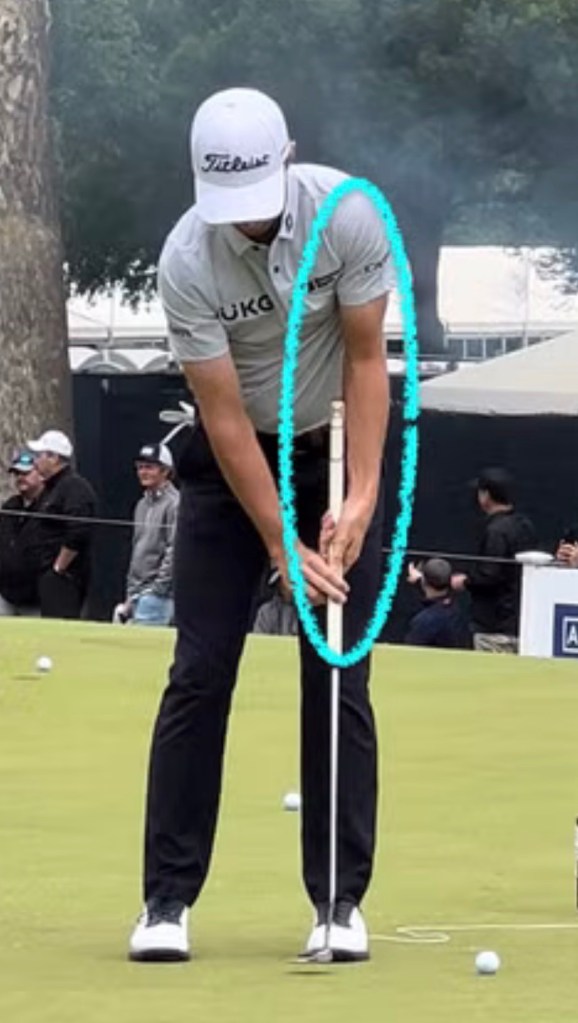
So again we seem to have total confusion. Anchoring is not allowed, if it is to the chest, but it is allowed if it is to the arm! Again – clear as mud!
But there is a simple solution.
Iain Carter made reference to it in his article: ban long putters! As Eddie Pepperell has argued in his blog and on The Chipping Forecast the putter should be the shortest club in the bag and it must be held in the hands. Simples!
Come on R & A and the USGA – remove any ambiguity and confusion in anchoring by making it impossible! The putter should be the shortest club in the bag and held in the hands!
4: The AimPoint method should be banned. Period
I’ve left this to last as its the most crontroversial suggestion: ban AimPoint. It’s slow, it involves trampling all over the green, it often involves the caddy walking all over the green, it’s copied by amateurs and even children competing in “Drive Chip and Put“.
With regard to the latter a young competitor slowly (indeed very slowly!) went through the process and even the Chairman of Augusta passed comment. Subsequently Augusta banned the process in future iterations of “Drive Chip and Putt” as well as introducing a shot clock: good for Augusta!
Most of the amateurs that I watch performing (laboriously) AimPoint seem oblivious to what they are actually trying to do, probably as they’ve watched it on TV but have never been properly taught the subtleties of the process.
Moreover, for those of us of slightly more advanced years the sensing of slight slopes by means of foot pressure is of dubious validity, as proprioception (the sensation of position of parts of the body) is a sense that diminishes in sensitivity with age. I wrote about this in an earlier post.
The PGA Professional Brian Harman made an important comment some time ago, and I think he’s absolutely correct: green reading is not in the feet, it’s in the eyes! The acid test would be to blindfold players using Aim Point and see if they had the same results. Obviously that kind of experiment is fraught with methodological issues, but its hard to believe that vision isn’t providing most, or at least a large part, of the perceptual cues!
Come on R & A and the USGA – let’s just do away with the AimPoint method and speed up play! At the very least, restrict the traipsing all over the line to the player and not the caddy!
Summary
So those are some thoughts on tweaks to the Rules of Golf in relation to the putting green.
Four tweaks to rules that would be simple to effect and that would really speed up play on the greens.
Might we ever see any of this? For Long putters and Aim Point – not a chance: vested interests and legacy issues will prevent these things changing!
Remember that when the original anchoring rule was introduced on January 1, 2016, after a three-year adjustment period there were howls of outrage and threats of legal action. An AimPoint ban would almost certainly have a similar response. But maybe there are intermediate steps like banning caddy’s being involved and implementing a shot clock for putting as Augusta have implemented for “Drive, Chip and Putt”?
Pin out/Pin in issues and the interminable remarking of the ball on the green, however, are perhaps simpler goals to achieve, and would have a very positive impact on the game we love.
We can always hope 🤷♂️
I will be interested in your thoughts!
While on the subject of the rules of golf . . .
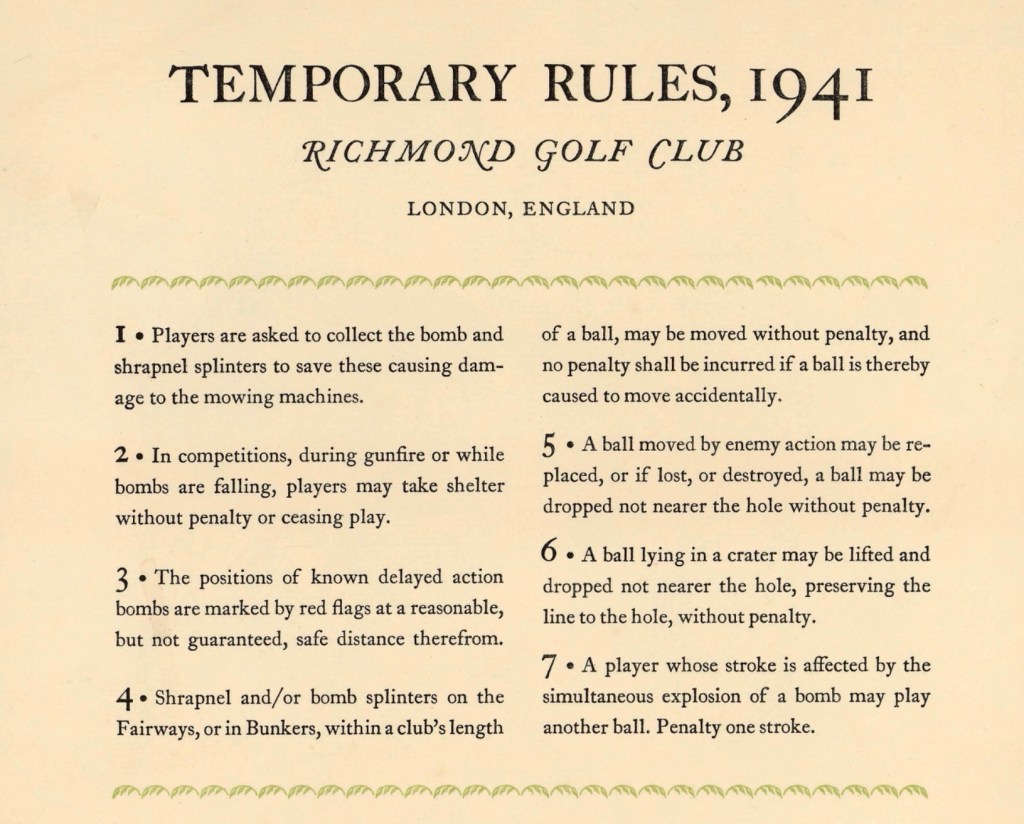
. . . and whilst not strictly in the rules of golf this is a rule worth noting!

From the archive
If you found this post of interest please share it with others and please subscribe to Craigavad golf
You may also be interested in Craigavad miscellany where I gently dive into mathematics, science, the natural world and other areas of interest.


Totally agree on all four suggestions.
LikeLike