The venerable game of golf has a long history. Golf has been growing for sometime. Since the Covid pandemic the success of the game has progressed even more with participation levels increasing worldwide wide. Two bodies The R&A and USGA have had a major role in that history and in that growth. Indeed they have the crucial role of administering the game including regulating the rules and developing the game. They also run really important amateur and open championships (open in the sense that anyone amateur or professional can enter).
As custodians of the game they do a difficult and essential task. Moreover they do a really fantastic job in so many ways! It can’t be easy juggling the disparate needs of many millions of golfers, both amateur and professional, in diverse jurisdictions. There is so much to be very positive about regarding what they do. But, and it’s an important ‘but’, there are occasions when what they do things (or plan to do things) that seem quite baffling.
Over a series of blogs I try to dissect a number of these baffling (at least to me) decisions. Some relate to equipment and equipment related rules and some to do with handicap issues and particularly the World Handicap System. My first topic was the WHS where I discussed the failings of the World Handicap System, and some possible solutions. You can find it here.
Now, in the second in the series, I will turn to the golf ball. This key item of golfing equipment has an interesting history that I will briefly outline. I will consider how the technology developed and then why and how The R&A and USGA have mandated a “roll-back” such that it flies less far.
Sadly, as I will argue, their actions are simply far too little and far too late. Furthermore, their actions are a “sledge hammer to crack a nut” and the hammer will miss . . . completely!
The history of the golf ball is inseparable from the history of the game itself. Changes in ball construction have repeatedly reshaped how golf is played, how courses are designed, and how skill is defined. Long before the current era of multilayer urethane balls and launch-monitor optimisation, golfers experimented with a range of materials. Each transition represented a technological improvement and a change in the balance between power, control, durability, and cost.
For most of golf’s history, the evolution of the golf ball was a story of materials and construction methods gradually improving distance, durability, and consistency. Early wooden balls gave way to the leather-and-feather “featherie,” which dominated the game for centuries despite being expensive and fragile. In the mid-nineteenth century, the gutta-percha ball transformed golf by making balls cheaper, tougher, and easier to manufacture, while the accidental discovery that scuffed surfaces flew better led to the deliberate development of dimples and the first scientific understanding of golf-ball aerodynamics. Around 1900, the wound rubber-core “Haskell” ball produced another major leap, dramatically increasing distance through elastic energy return. During the twentieth century, manufacturers refined this architecture with softer balata covers for spin and feel, improved dimple patterns, and increasingly precise industrial production. By the late twentieth century, however, golf ball technology had settled into an apparent compromise: high-performance wound balls offered elite control but poor durability, while solid two-piece balls provided distance and consistency at the expense of finesse.
The arrival of the Titleist ProV1 in 2000 shattered that compromise: it was revolutionary. Its multilayer solid-core construction combined low driver spin, high short-game spin, durability, and manufacturing consistency in a single design, effectively eliminating trade-offs that had shaped the game for decades. Professionals adopted it with extraordinary speed, and the consequences extended far beyond a few extra yards. Combined with large head titanium drivers, launch-monitor optimization, and modern athlete conditioning, the ProV1 era accelerated the steady rise in driving distances visible across professional golf. Hazards lost strategic relevance and power increasingly dominated elite play. Part of the response to this was the lengthening of courses, and some venues just became to short to host elite events. By the 2020s, governing bodies faced a problem that had been building for two decades: how to respond to a technological and other changes that had fundamentally altered the game in terms of how far the golf ball flies.
The issue of how far golfers (and especially elite professional golfers) can hit the ball is not new. The PGA Tour website has detailed statistics going back as far as the 1987 season. Among the myriad categories is Driving distance (based on the average of two holes per course per round) and also Longest drives (using ShotLink data). The latter is clearly heavily influenced by the course set up, ground conditions, wind and peculiarities of the course design.
Here is the top five for the “Year to date” data accessed on June 1st 2026 for Driving distance.

The “Longest drive” data are quite phenomenal. Here are the top five. Notice Wyndham Clark’s 446 yard drive on the 10th hole at Copperhead.

It’s of note that Aaron Rai, considered a short hitter (and 154th in the list of 165 players), has an average drive length of 291.1 yards (the Tour average is 303.9 yards) but a longest drive of 343 yards (with the Tour average being 351 yards). Monstrous hitting but short in comparison with many of his peers.
Big hitting is not new and is not only a consequence of golf ball (and golf club) technological changes. What is the longest drive in Masters history? Until recently it was struck at the 1996 Masters: 30 years ago! As an Amateur, Tiger Woods averaged 342 yards off the tee with driver! Its worth reading this report of the event. This was at a time when “big hitters” like John Daly rarely drove 300 yards and the PGA Tour average was about 289 yards. Its worth remembering that this was with before ProV1 golf balls and big-head drivers. How did Woods achieve this feat? Fitness, conditioning and technique! It clearly wasn’t the golf ball! Perhaps it’s worth holding that thought!
Now look at the progressive increase in distance over the last 3 decades in the professional game. While there is arguably an an increase in the rate of increase in the 1990s and around the launch of the ProV1 distance has been increasing year on year since the 1980s in both the mens and womens professional game.

While annual increases were modest, the long-term trend was unmistakable. Importantly, distance gains were not confined to the longest hitters; the entire distribution shifted.
It’s worth diving a little deeper into the numbers. There is a progressive increase in driving distance and carry distance but the most notable feature is clubhead speed. Every single year the average speed gets slightly faster: everything else follows from this. And where does the clubhead speed come from? Fitness, training, gym work, diet, fitness, training, gym work . . . and then rinse and repeat!

In the amateur game improvements in distance are less dramatic (perhaps we spend less time in the gym!) The R & A have published a detailed analysis of driving distance in the amateur game over the period 1996 to 2018. You can find it here. Below is a key figure that shows that for no handicap group has there been very much change, perhaps some increased length for higher handicap players. There might be a difference comparing pre 2000 with the ProV1 era.

But it is in the professional game that the impact in increasing driving distance is most obvious. Players like Rory McIlroy can simply ignore the usual way of playing a hole and launch a ball over huge trees. Look at this example from the 14th hole at Pebble Beach on his way to an eagle and a Championship win.
How much of that is the ball? How much is the rest of the equipment? How much is the tuning of the ball to the equipment – all of which is tuned to a superbly honed athlete with fantastic technique and who is at the peak of their game? Is it any one of those elements that allows McIlroy to hit huge towering drives or is it the synergy of all those elements?
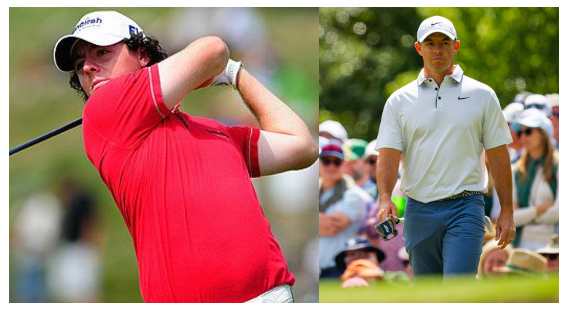
Again using the example of Rory McIlroy, compare his physical appearance when he won the 2010 Ryder Cup with his appearance 14 years later when he won the 2025 Masters. In the intervening period he became a gym bunny! Now all the elite golfers are powerful and honed physical specimens. Strength and speed training is central to their preparations for golf. As I wrote above: Fitness, training, gym work, diet, fitness, training, gym work . . . and then rinse and repeat!
But of course there is a real, and arguably very negative, consequence of the huge distances that elite professional golfers have been hitting the ball: they can simply over-power traditional courses reducing them pretty much to “drive, pitch and put” competitions. Concern about this has a point of discussion for many years. Some architects took the approach of “Tiger-proofing” courses by making hole longer . . . and longer. This was not so much Tiger-proofing as playing into the hands of Woods and other big hitters. Many layouts simply cannot be lengthened and examples include gems such as Merion and even The Old Course where space is really limited.
The real problem, and particularly since the introduction of the ProV1 (and all the other multi-layer balls that incrementally become ‘better’), is that the changes were slow: small year on year changes. Moreover they were coupled by small incremental, year on year technological improvements in drivers and other clubs and small year on year enhancements in training and physical conditioning. It’s the classic boiling frog analogy! And the response of the governing bodies was simply far too slow: lots and lots of hand-wringing and a complete absence of action!
But by the mid to late 2010s there was growing concern. Defenders of the status quo argued that athleticism, fitness, and technique were the primary drivers. Critics countered that equipment, and especially the ball, was the dominant causal factor. Both sides were partly correct, but some felt that the ball occupied a unique position: unlike clubs or player training, it affected every shot by every player.
At last the governing bodies (egged on by others such as the Augusta National Golf Club) decided to act. “The golf ball is going to far” was the cry and so the answer was obvious . . . “so lets do something about the golf ball” was the response. The golf ball: thats what we need to change! So the idea of a “roll-back” emerged. Too little, too late!
Few regulatory decisions in modern sport have provoked as much sustained controversy as the golf ball “roll-back.” Announced by the USGA and The R&A in the early 2023 and scheduled for elite implementation later in 2028 (and likely to be delayed to 2030), the rollback seeks to reduce the maximum distance a golf ball can travel under test conditions.
How would that work? Quoting from a recent Golf Channel article by the very well informed Rex Hoggard: The new Overall Distance Standard (ODS), which would roll back the ball for elite players by 13 to 15 yards in driver distance, is based on changing the “testing conditions” and would increase to a 125-mph clubhead speed and an 11-degree launch angle from the current 120-mph clubhead speed and 10-degree launch angle. The testing limit of 317 yards (with 3 yards of tolerance) remains unchanged.
Here are the predicted changes
- A 13- to 15-yard decrease for the longest hitters
- A 9- to 11-yard decrease for average pros
- A 5- to 7-yard decrease for female pros
- A 5-yard or less decrease for most recreational golfers
Its stated aims are to “pause” the increase in distance (so not much of a roll back then!) and by that means preserve course relevance, curb environmental and economic pressures associated with ever-lengthening layouts, and protect the long-term integrity of the game. Yet for many observers, the rollback feels simultaneously radical (such a step has never been tried in golf before) and totally inadequate, an intervention that arrives decades after the problem emerged, and that addresses only a fraction of its causes. Hence the increasingly common verdict: too little, too late.
As well as the strong message from The R & A and the USGA, Augusta National Golf Club are strongly in support of the “roll-back”. Augusta’s Chairman Ridley recently made it clear “failure’s not an option“. But fail it will! The roll-back will not, indeed cannot succeed. It’s too little and too late. That it is too little was suggested by Gary Player who suggested a real roll-back of 60 yards was needed for it to be truly effective.
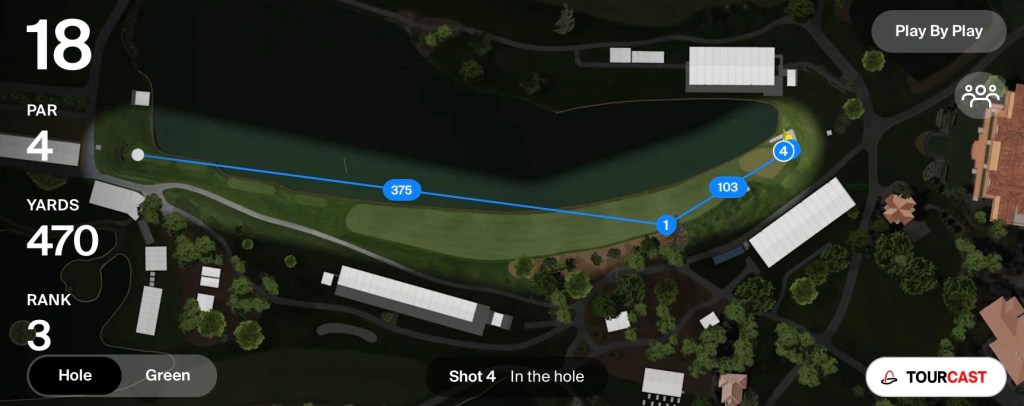
For supremely conditioned elite golfers, who are now toned athletes, a few yards roll-back (as envisaged) is essentially meaningless. Moreover many are already using balls that are not optimised for distance and are probably already “conforming” under the new regulations. For example, at the Players Championship in March 2026 Cameron Young was using a golf ball that would be conforming under the proposed new testing guidelines! This was also reported by other sources. Yet this is the same golf ball he used to hit a tee shot 375 yards at The Players Championship as seen from this screenshot of ShotLink data from the PGA Tour!
What do professional golfers in the PGA Tour think? Well recently Adam Schupak of Golfweek wrote “I feel a majority of guys out here are under the same opinion I am, that there isn’t a problem with the golf ball … I don’t know why we’d let a group of amateur golfers decide how we play the game”. It’s worth reading the whole article.
Here are some other thoughts from balanced, thoughtful and respected Tour professionals.
“I just feel like they [the R&A and USGA] are not going to achieve what they want to achieve the way they are going about trying to roll-back the ball,” said Adam Scott, who added that he experienced roughly a 2-yard drop in driving distance when he tested a golf ball that would be conforming under the new standard. A whole two yards!
Here’s another comment. “It’s laughable that they think we use the longest golf balls that are available to us. They think we optimize for distance, that’s ludicrous,” Lucas Glover said. “Nobody hits the ball we can hit the furthest, we use a ball that’s the best all around. A lot of guys use a ball that doesn’t go as far for more feel.”
A very recent discussion occurred on the “Rex and Lav”, Golf Channel Podcast on June 3rd 2026 (listen from 20 to 26 mins). Rex Hoggard reported that Mike Whan (CEO of the USGA) spoke at a meeting of the PGA Tour players held prior to the Memorial Tournament. Hoggard reported that the rank and file are very strongly against the roll-back. He used words like “entrenched“, “dug-in” and “polarised” to describe the rank and file view. The Tour itself, as well as the players and the manufacturers, are absolutely against the “roll-back”. He suggested that there is a ground swell in the tour that something needs to be done was that “this solution is not a fix” and “it’s just not going to work“.
Hoggard made another observation that is important. If the “roll back” as currently envisaged is indeed implemented in 2028 (or more likely 2030) then three of the four majors The Masters, the US Open and The Open would be played under the new rules. Only the PGA Championship would not as the PGA of America are strongly against the “roll-back”)! That’s going to be a conundrum!
He finished by speculating that from the Tour’s perspective and the players that any “fix” needed a broader approach that was (my words) “more holistic” and involved not just the ball but other elements of golf technology including shaft length and driver head size. These ideas have been mentioned before. Maybe the wrong bit of equipment is being changed?
Drivers have changed beyond recognition over the past 30 years. Here is a recent article that makes that argument very persuasively. To paraphrase that “Today’s Golfer” article by Robb McGarr, today, most drivers are 460 cc, made of titanium and other materials with optimised weight distribution, moments of inertia and coefficients of restitution that provide unimaginable forgiveness. although on longer and optimised shafts they are easy to hit, stable and have less dispersion even with poor off centre strikes. Thirty years ago players used persimmon heads of 190 cc and steel shafts. That dramatic evolution changed behaviour as the penalty for mishits was reduced.
McGarr finished “When the penalty for mishits is reduced, players can swing at 100%, knowing the club has their back if they don’t strike the middle. That’s where modern drivers have had the biggest impact”.
How big is that impact? A recent article suggested that with current technology the Tiger Woods of 2000 (when he was the worlds longest) would hit the ball an average of 320-325 yards in 2026 – some 20-25 yards further than in 2000. That increase would be (predominantly) because of improved driver technology.
What is absolutely clear is that, in the same way that the R & A and USGA did nothing about the golf ball for a quarter of a century, they equally did absolutely nothing about the dramatic evolution of the driver (and other clubs). This has all contributed to the distance problem!
Something needs to be done. From what I’ve read it seems that view is shared by the Tours and the Professional players, but there is a strong view that in the professional game the proposed “rollback” is just not going to have the desired effect. All the evidence says that!
Were the R & A and USGA “asleep at the wheel“?
No it’s much worse! As custodians of the game they were arguably negligent!
So what can be done? I have some thoughts. I’m sure you do as well. Please make suggestions in the comments below.
If you’ve found this post of interest please share it with others and subscribe to Craigavad golf
You may also be interested in Craigavad miscellany where I gently dive into mathematics, science, the natural world and other areas of interest.
A recent post focused on golfer Bryson De Chambeau and his interest in big conspiracies.


Wouldn’t it have been easier (and cheaper) to limit the driver loft to 9° and above (little impact on amateurs)? Or ban shafts that are above a certain stiffness?
Would measures like these help reduce the distances that the balls carry?
LikeLike
Good points!
There is no doubt that something needs to be done.
The ball alone, and just a homeopathic tweak, is clearly not enough. Moreover the proposed ball change is uneven: some professionals with low ball flight and low spin are massively affected. In contrast behemoths with high ball flight high spin will not be impacted. So it’s inherently unfair.
So a much broader range of changes are needed. They might include a ball tweak, a club head size reduction, an MOI reduction, a shaft shortening, a tweak to maximum smash factor, and considerable tweaks to course set up.
For example at St Andrews internal OB would massively restrict “hit it as far and as left as possible” strategies. Thus (1) making it safer and (2) putting a premium on accuracy over length. None of this need to impact you and me as regular amateur golfers!
But it’s still the case that the USGA and R&A should have acted 25 years ago!
En passant, while researching my piece of 2004 Shinnecock US Open I learned that it was indeed in 2004 that the authorities mandated the maximum 460 cc head size for drivers. What were they thinking!? 🤦♂️🤷🏻♂️
LikeLike
The rollback debate always seems to come back to the same problem: what makes sense for elite players does not always feel right for regular golfers. Most amateurs are not overpowering golf courses, so any change that makes the game less enjoyable for them needs to be handled very carefully.
LikeLike