This is the first in an occasional series of posts where I take a hard look at the governing bodies of golf, The R & A and the USGA.
Both organizations oversee the whole of golf and do, in many ways, a really fantastic job. It can’t be easy juggling the disparate needs of many millions of golfers, both amateur and professional, in diverse jurisdictions.
Nevertheless, for all their efforts and hard work, there are a number of areas where there is controversy over their actions, and occasionally, their inactions. Pace of play, equipment, the complex rules of the game, handicap systems are but a few areas where their decisions have received criticism.
In the series I try and delve into some of these issues.
I’ll begin with the controversial World Handicap System.
Handicaps are a fundamental feature of amateur golf. Robust and meaningful handicaps allow golfers to monitor their progress and development and, crucially, they allow fair competition between players of different ability. For all concerned to have confidence, the handicapping system should be transparent and fair. Moreover, while it is likely that some of the statistical underpinning of any handicapping system may be complex, the general principles should be understandable to all concerned.
There are some really important words in that short paragraph: robust, meaningful, fair, confidence, transparent, understandable. If any of them are not applicable to a handicapping system then general acceptance is pretty unlikely and the system will lack credibility.
So with that general background what is the World Handicap System (WHS) and how does it perform?
The WHS was introduced in 2020 as a joint initiative by organizations such as the R&A and the USGA to unify the various handicap systems that had developed independently around the world. Before this, golfers in different regions (e.g. CONGU in the UK & Ireland, USGA in the US, EGA in Europe, GolfRSA in South Africa) played under different rules, making international competition and comparison inconsistent.
At its core, the WHS is built on a few key principles: it aims to measure a golfer’s demonstrated ability based on recent performance (using the best 8 scores from the last 20), adjust for course difficulty through course and slope ratings, and provide a portable handicap that can be used anywhere in the world. The system also incorporates safeguards, such as caps on upward movement and playing condition corrections, to ensure handicaps remain reflective of ability without fluctuating excessively. It is intended that a card is submitted every single time you play!
By allowing scores from a broader range of formats (including general play, not just formal competitions) and by (hopefully) making handicaps more responsive to recent performance, the system encourages golfers to submit scores more regularly and feel that their handicap reflects how they are currently playing. The idea is that if players see a clear, fair link between effort, improvement, and their handicap index, they are more likely to stay motivated, compete, and remain active in the game.
In short, beyond standardisation, the WHS is designed to make golf feel more accessible, relevant, and rewarding, allowing all golfers the opportunity to measure how they are playing against an objective parameter, their handicap index.
Fundamentally it’s designed to be a fair system and be based on sound statistical principles.
Anyway, those are the core aspirations!
You can read more about what the R&A and the USGA hope to achieve and the details of the system at the WHS website. The FAQ page of WHS is particularly informative.
Before we move into the discussion of WHS it’s important to acknowledge and congratulate the R&A and the USGA on progress to date. Getting six different handicap systems and dozens (and now more than 130) countries to come together with a (fairly) unified system was no mean feat! That must be recognized!
That WHS is now operating in more than 130 countries might point to its success. In addition, there is on the WHS site, a 15 page report on the performance of WHS in 57 of those countries in 2025. It’s very interesting reading, being based on data from about 6.5 million golfers and more than 150 million rounds. Again those are metrics might point to the success of WHS.
A lot has been written and said about WHS. Many are very critical of it! It’s even be called “a cheats charter”. Such criticism comes from all levels of the game and is not restricted to the elderly retired clubhouse bores!
But let’s be very clear WHS is not going to go away!
Here, as an enthusiastic and engaged amateur golfer who plays (and competes) in two jurisdictions (as a member of the Spanish Federation and of Golf Ireland) and who submits in excess of 50 competition cards a year, I want to highlight what I see to be the most significant failings of the system.
Now it’s all too easy to be negative and critical, and arguably that’s not very helpful. Rather I want to both highlight failings and (recognizing that WHS is here to stay) to suggest ways that the system might be improved.
At the very least I hope to promote wider discussion.
Failures of the WHS roll-out process
It was extraordinarily unfortunate that the worldwide implementation of WHS should coincide with the beginning of the devastating Covid 19 pandemic.
Living in Northern Ireland at that time, the rollout was essentially invisible. Some jurisdictions had a soft start earlier and for others it was later, but it seems likely that much of the failure of understanding of the system can be tracked back to a failure of the information transfer and the educational processes. That lack of understanding remains prevalent to this day!
Casual conversation with other golfers from different countries continues to highlight variable, but often major, lack of understanding of how WHS works. PCC, soft and hard caps, course ratings and slopes, performance review and even the need for regular submission of scores are often apparent mysteries to many golfers. Some even fail to grasp the average based nature of the system and how after a good score ones HI can paradoxically go up (because a better score dropped out of the counting 20).
Much of the negativity surrounding WHS could have been avoided – and could still be mitigated – by more effective information and education. The WHS website has great educational materials but it is not actually getting to much of the golfing community. Indeed it seems that many golfers see WHS merely as a different way to get to the same number, when of course it has a totally different underlying philosophy.
Such lack of understanding of the system has to be the responsibility of the various National Federations and Unions. The clubs must also take their share of the blame.
Having said that Golf Ireland have been much more proactive in this recently and this is welcomed.
Clearly this needs redress. The educational processes need massive improvement.
Jurisdictional differences
Different countries have very different approaches to golf and particularly competitive golf.
In the USA the average male handicap index (HI) is 14.2, while in the British Isles it around 17.5. Are British and Irish men 3 shots worse golfers than American counterparts? That seems pretty unlikely. The differences may relate to climatic issues, to different frequency of casual general play round cards as opposed to competition cards and maybe to other behaviours. From personal experience “gimmees”, Mulligans and ‘breakfast balls’ are not uncommon in the USA but vanishingly rare in Europe.
In South Africa all play, however casual, is associated with the submission of a card. Indeed that is a central element of how WHS is supposed to operate. That idea is poorly understood in many jurisdictions and certainly in the former CONGU jurisdictions not complied with.
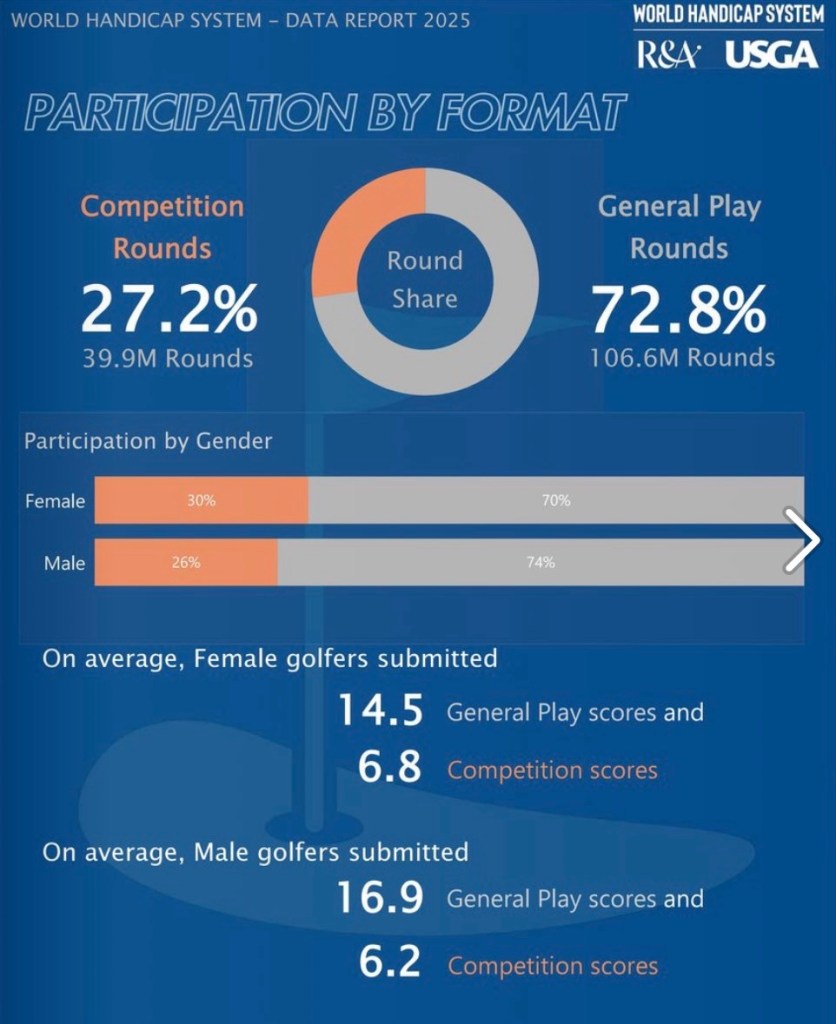
Around the world there are very different approaches to golf and particularly competitive golf and the prevalence of general play (casual round) cards. In many jurisdictions they are common place and may predominate. Indeed from the 2025 report overall from the 57 countries nearly three quarters of submitted cards were from general play. This is unlikely to be reflective of the former CONGU jurisdictions nor of Spain. It’s unclear why WHS does not provide that data rather than the summary statistics that hide key facts.
Jurisdictional differences even apply to the way WHS is used.
For example, one notes with interest that for many elite amateur events in England entry may be denied if too many returned scores in a players HI calculation are general play scores. Quoting from an article in National Club Golfer:
Aiming to protect the integrity of elite amateur competitions and ensure tournament play was a major factor in entering the most prestigious events, it filtered entrants who had more than four general play scores in their most recent 20.
They were then assessed to look at the difference between their ‘Competition Score differential and the General Play differential’.
Where a difference of more than two strokes was identified, a player was told their entry into the championship was denied, and their club and county were informed.
James Crampton, England Golf’s director of championships said:
We haven’t got exact numbers, but we probably think we denied in the range of 50 to 60 players across the season from entering our championships because that differential was greater than two shots.
Here is another example the prestigious Oscar Ash Cup. On the competition website we read
“An entry may be refused if, in the opinion of the Championship Committee, a player’s handicap index is not reflective of their playing ability.”
“This decision may be based on but is not limited to: (a) A handicap record (most recent 20 scores) that contains more than four general play scores; (b) A handicap record (most recent 20 scores) that contains less than four competition scores.”
So WHS via the R&A and USGA want everyone to put a card in every time they play (general round cards) but governing bodies, county unions, clubs and competition organizers are concerned that this undermines the integrity of handicapping.
Indeed a recent article described general play scores as “the elephant in the room in WHS”. Further, Golf Ireland are trialling an adjusted strokes gained rating to determine entry into elite events. Yet another system! A recent National Club Golfer podcast has discussed this and also how the unified WHS may be becoming 4 in the old CONGU area!
It’s all a complete mess! And much of this comes from a unified system being applied and mandated indiscriminately to very distinct cultures and jurisdictions.
Those jurisdictional variations undermine the whole system!.
Problems with portability
A key claim for WHS is its portability. You can go anywhere in the world with your HI and play any course with a meaningful playing handicap.
That is sort of true.
But there are some major caveats.
In the early autumn I take my Golf Ireland playing record as a PDF to Spain. The local club cannot make changes, they must send that information to the Spanish Federation (RFEG) in Madrid where the data are manually added to update my Spanish handicap (in Spain the system is highly centralised). That synchronization process then means I play in Spain with the correct HI. Similarly in the spring I return to Northern Ireland with my Spanish playing record and my local club then updates my Golf Ireland record (the system is fully devolved).
All of this is manual and potentially error prone. The data in the two systems aren’t even presented or recorded in the same way. In Spain all records a centralised (and often very slow) and the local handicap convenor has little input or influence. In Northern Ireland the function is devolved to clubs with central oversight (another significant jurisdictional difference). The people involved in the process are doing a good job and no criticism of them is intended!
My wife and I are diligent in the synchronization process despite it being cumbersome and with occasional rather tedious discrepancies. We know others who simply don’t bother! Furthermore we know others who despite many attempts at synchronization have regularly failed to satisfactorily achieve this, usually because their home club refuses to accept the Spanish data.
Similarly I know a fellow golfer who plays competitions in the USA but whose home club refuses to accept those competition cards as “they are from the USA and they allow “gimmees” and Mulligans“.
Moreover I’m aware of other circumstances where students studying in one part of the British Isles are unable to synchronize handicaps because one (or both) ends of the process refuses to engage!
All of this is very problematic and undermines the notion of WHS portability. Yet the solutions are obvious and rather trivial!
1. Surely WHS should mandate that the data are presented everywhere in the same way and in the same format with a simple facility of data export and import? Even if the data are presented in different ways by different Federations and Unions, the ability to export and import with a common file format is an essentially trivial programming problem!
2. Similarly, one might reasonably suggest that WHS should mandate that data transfer and handicap synchronization is expected of all players and of all clubs (or designated authorities). It’s simply wrong that any players fail to synchronize their records and reprehensible that any club or body fails to facilitate such synchronization.
Those running WHS really need to fix this, and quickly, if the aspiration of portability is to be a convincing reality!
Course ratings: why not use real world data?
The Handicap Index is only one part of WHS. Accurate course ratings from all the different tees for a given golf course are crucial.
Traditionally this is created by a small number of very well trained individuals walking a course, measuring key things, hole length, position of hazards, fairway widths, rough and trees, bunkers, greens etc. Then by reference to a very secret tome (why is it so secret?) that data is converted via some similarly secret and proprietary software into a course rating.
A recent podcast by National Club Golfer explored the topic in great detail. Gemma Hunter, The R&A’s assistant director of handicapping was interviewed. If you have a spare hour do listen to it.
If you do I wonder what you’ll think? What struck me was the absurd and extraordinary waste of time and effort to get a vague guess of what the course rating might be!
All the Federations and Unions now have, for each course and each tee box for both genders, detailed WHS data going back at least five years! That data tells you how every hole is playing from every tee and probably for every handicap category! That data clearly contains all the information needed for accurate and robust course ratings. It would only be for a brand new course or if there was a major redesign that the manual method would be needed.
I’m sure the governing bodies will move that way in due course and then add a degree of science and objectivity to this crucial element of WHS.
At the moment one has little confidence in the robustness of course rating yet this is a key tool in how WHS works.
Lack of clarity on what a valid handicap actually is
What is a valid handicap index? This is a crucial question, but I’m not aware of it being addressed anywhere in the WHS documentation!
There is wide variation in what is perceived as “a valid handicap”. Let’s look at some examples:
To be eligible to play in my local club’s Captain’s Day you must have submitted three qualifying cards in the season, so from early April to Captains Day in mid June.
To participate and be eligible for prizes in any of the major golf competitions at La Manga it is typically six submitted cards (for some events it has been 8) in the prior 12 months.
Golf Ireland stipulate that to be eligible to play in Inter-Club competitions you must have at least 20 qualifying rounds and of that just four should be in the prior season. Four!!! Really?
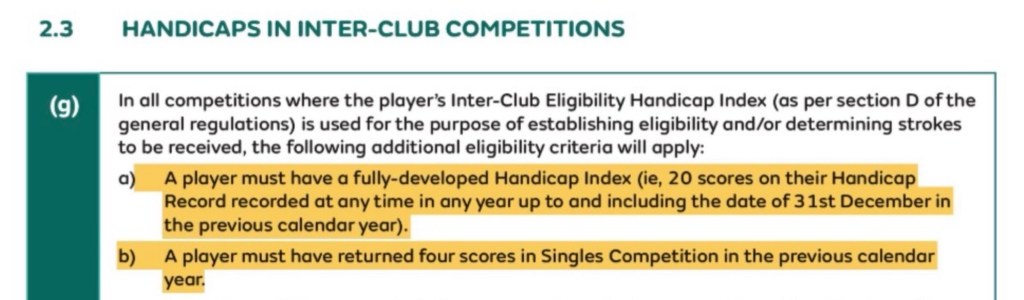
Put at its most stark (and thinking about the Golf Ireland regulation), how can you compare two players in an Inter-Club competition with the same HI but where one was accrued over many years (but is still ‘legal’) with one accrued over a single season? They are patently data of a different quality!
From my perspective all of the above requirements (including the one from Golf Ireland) are simply insufficient for handicap validity!
Before delving into that statement we should acknowledge that a retiree playing golf all year in sunny Spain is in a totally different situation to a busy 35 year old with a family living in Scotland and whose playing opportunities may be dramatically different and very limited. Circumstances must be factored into the discussion!
Nevertheless, for any average based system the reliability of the average as a measure must be dramatically influenced by the numbers involved and specifically the number of cards submitted. If you’re only submitting four cards a year (enough for a valid handicap for Golf Ireland inter-club matches), your HI is based on 8 best cards from 20 accrued over five years! I’m sorry but that just not credible! A HI based on 20 cards over five years is junk data!
So what number of cards over what time period is sufficient to get a meaningful HI? That’s not an easy question to answer but there are a number of factors to consider. En passant, where everyone is submitting a card every time they play, as in South Africa, this question is moot.
A feature of Category one golfers is that not only are they very good, they are very consistent! Category 3 players can often hit great shots but are inconsistent. Category 2 players lie in between. Category 4 players are typically very inconsistent! The variance in the typical scores of these four different groups increases as their handicaps increase. This is not handwaving, its obvious to anyone who looks at the scores from golf club competitions. Moreover it’s supported by real world data such as the following from the USGA.
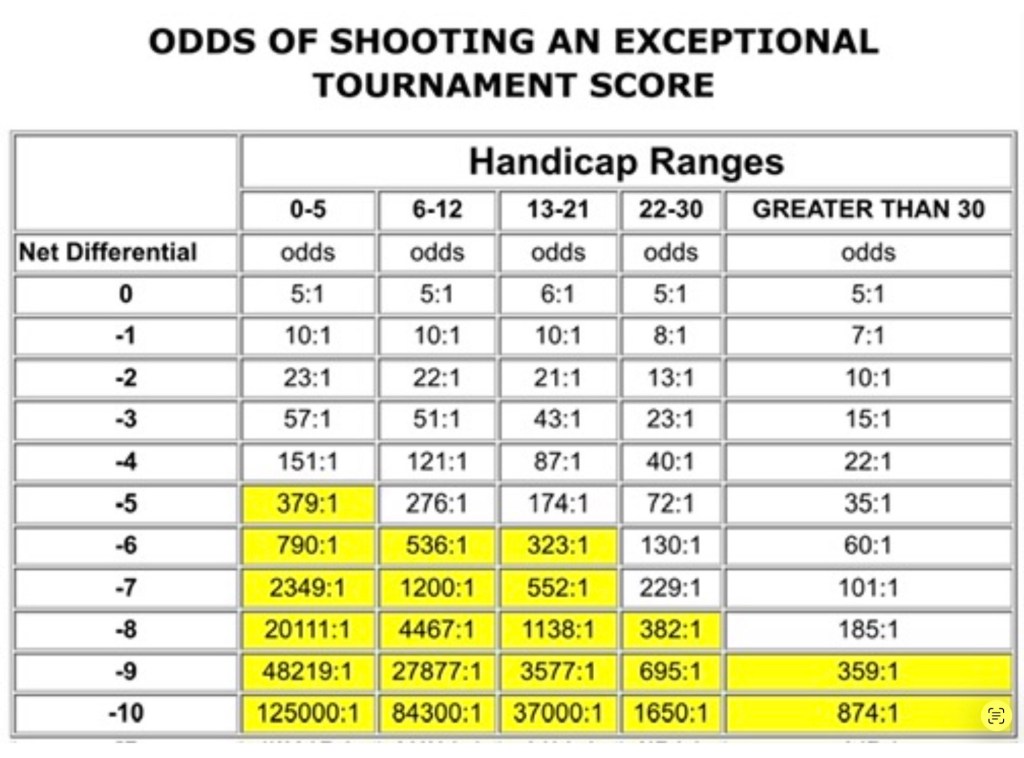
We can use that data and build a mathematical model where we ask, for players of different basal HI, and with different variance on their likely scores how many cards need to be submitted to have a better than 80% chance (chosen arbitrarily) of the HI being within two shots of the correct HI. It’s a model and so needs to be treated with caution. There are assumptions. Nevertheless it makes it very clear that for different categories of player you need different numbers of submitted cards to have confidence that the HI is roughly correct.
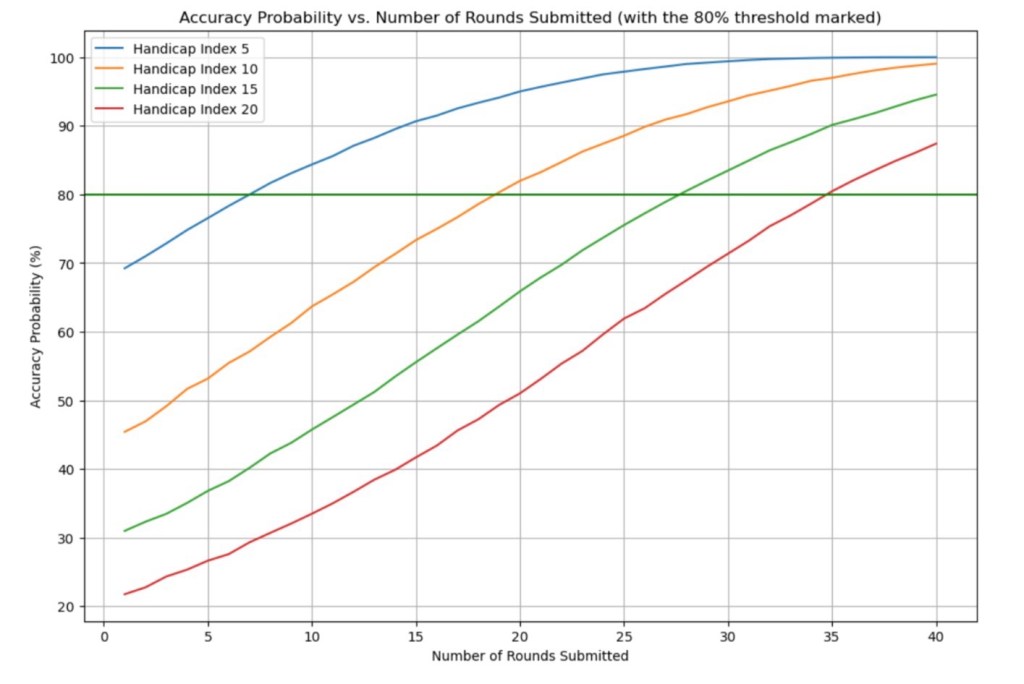
This is not unexpected! But it speaks to the issue of what is a valid handicap! Because they are more consistent better golfers ‘need’ fewer cards for a valid HI. Less able golfers who are less consistent need many more cards from their HI to be a reasonable reflection of their playing ability.
It follows that it’s not just the number of cards that matters but (1) the general ability of the golfer and (2) the timescale over which the cards are submitted!
How can that all be built into WHS?
Mandating a specific number of cards in a given period is probably both Draconian and unworkable, not least because of the scenario I outlined above of the busy 35 year old from Scotland.
However, education is probably central coupled with various bodies increasing the number of cards needed to be eligible for competitions.
A final thought is that the HI might in the future be made up of two numbers, the extant HI followed by, in parentheses, the number of cards submitted in a rolling 12 month period. So for example Joe Bloggs 14.6 (3) versus John Smith 14.6 (18): the confidence in the 2 HI are clearly different. John’s 14.6 is a lot more robust measure than Joe’s!
This approach lets everyone know the evidence base for the HI, and simultaneously emphasizes the need for regular and recent card submission. By building it into the system it drives engagement.
Clarity, and consistency, on what constitutes a valid handicap is needed!
The handicap index is often not comparable between players: the need for time series data
Consider three players (Tom, Dick and Harry but it could be Sandra, Sheila and Samantha) with exactly the same handicap index. Let’s suppose it’s 17.6 which is about the mean male HI in the UK and Ireland. They play in a regular weekly threeball and submit the same number of cards (20) over a 20 week period.
Tom was playing very well but has “gone off the boil”. His 8 counting cards are all in the first ten scores (front loaded) with the next ten all being non-counting.
Dick is a master of consistency. Solid. Unwavering golf. His 8 counting cards are evenly distributed across the 20.
Harry was playing very poorly but lots of hard work and lessons have led to dramatic improvement and some great golf. All his counting 8 cards are in the last 10 games (end loaded).
Yes, the average of best 8 from 20 are exactly the same for Tom, Dick and Harry but their actual playing potentials today are clearly not the same. Tom is likely to be worse (and possibly much worse). Dick’s next game is likely to be about at his HI and Harry is more than likely to have a great round next. The current WHS system completely fails to take these dramatic differences in time series into account, yet they can dramatically alter the confidence with which a players HI is viewed.
Consequently, and by dint of this reductio ad absurdum, one must conclude that, as a measure of playing potential, that without consideration of time series effects, that the current WHS is fundamentally flawed and thus arguably not fit for purpose.
Things of course get worse when one adds another player, let’s call him James, to make a fourball. Maybe James’ HI is exactly the same as Tom, Dick and Harry but rather than be accumulated over 20 weeks (like his playing partners) has been accumulated over 5 years (he puts in just four cards a year). Now how can we possibly compare the HI of the four players? Clearly we can’t! Apples and oranges are being compared!
In many ways the time series discussion brings us back to the consideration of what constitutes a valid handicap. One might reasonably argue that James’ HI lacks any validity, and is certainly much less robust than Tom, Dick and Harry’s.
In addition, adding some factor (a multiplier) that reflects the gradient of counting scores in the 20 might usefully tweak the HI and make it more reflective of current ability. So
- For a front loaded time series like Tom’s (recent scores are non counting) the factor might be 1.1 so the effective HI goes up slightly.
- For a flat time series like Dick’s (counting scores are evenly distributed) the factor is 1.0 so there is no effect on the HI, and
- For an end loaded time series like Harry’s (recent scores are mainly counting) the factor might be 0.9 and so the effective HI goes down.
Obviously a lot of work would be needed to determine the appropriate size of any time series factor or factors. There’s a nice Masters thesis in that I suspect!
Time series issues need to be addressed.
The remarkable thing about this is that the data is already in the system. It merely needs a relatively simple algorithm to extract a suitable time series factor!
Failings of the Playing Condition Correction
As an outdoor game golf is subject to the vagaries of the weather. Some means of adjusting scores for significantly adverse conditions (or even very favourable conditions) seems fair and reasonable.
The Playing Condition Calculation (PCC) in the World Handicap System is essentially the successor to the old CSS (Competition Scratch Score) used under systems like CONGU, but the philosophy and mechanics differ in some important ways.
Under the earlier CONGU-based systems (as used in the UK and Ireland), CSS was calculated within a specific competition only. It adjusted the day’s “target score” (the equivalent of par for handicap purposes) based on how players in that competition scored relative to Standard Scratch Score (SSS). If scoring was poor overall, CSS went up; if scoring was good, it went down. That adjusted figure then determined who had “played to handicap” and who received handicap cuts.
PCC, by contrast, operates at the level of all acceptable scores returned on a course that day, not just a single competition. This is a structural shift: WHS is built around continuous handicap updates from all rounds, so PCC reflects the broader playing population, not a subset. It has (we are assured by WHS) a solid base in statistics, seeking to discern whether the distribution of scores deviates from the expected distribution, and by how much. The details are not forthcoming.
You can find a nice discussion of PCC here.
In the 2025 data review from 57 countries PCC adjustments were applied to 8.9% of submitted scores.
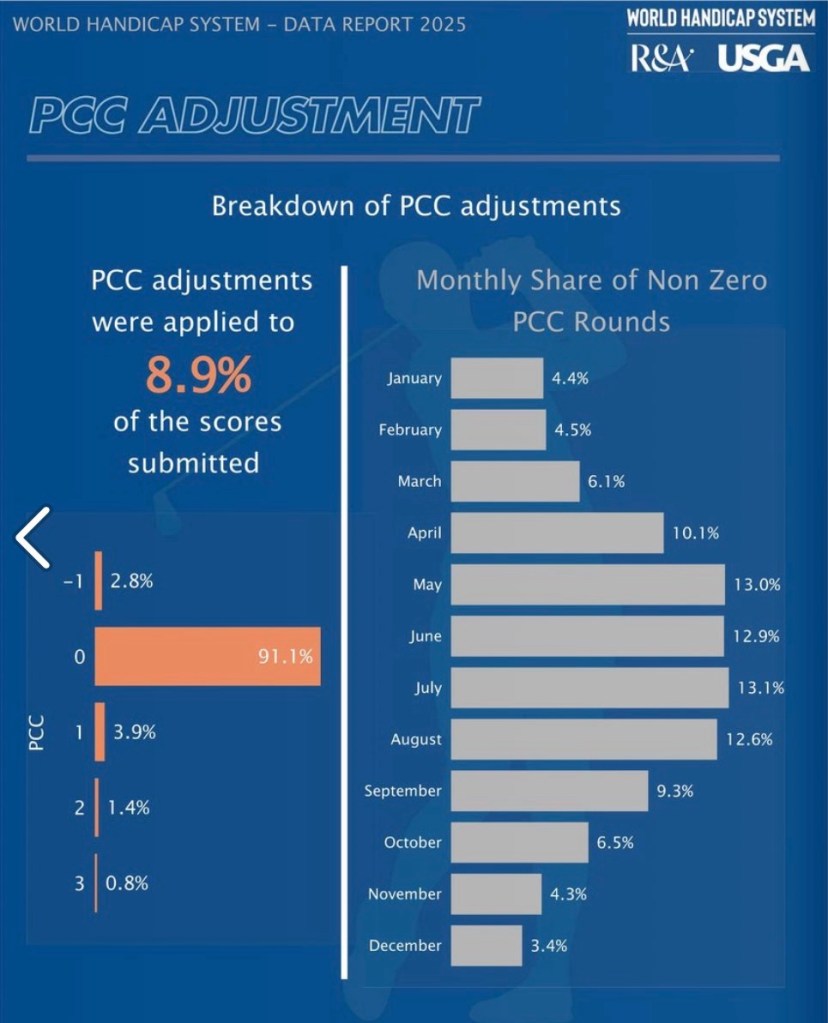
The right hand panel is meaningless and impossible to interpret as there are countries from both hemispheres (see page 11 of the report). Data is not the same as information! The left panel is perhaps as expected although 2.8% with a PCC of -1 is surprising!
The mechanics of PCC are largely invisible. WHS keep all the details hidden claiming “it’s proprietary”. Presumably the algorithm “knows’ what the distribution of “normal” rounds looks like and then compares the distribution of the days rounds on a given course from specific tees. Use of the z-statistic would be an obvious tool. The further the distribution deviates from the usual the larger the PCC alteration. Presumably thresholds are applied based on field size and maybe (as with CSS) field handicap structure. The absence of transparency is troubling and undermines confidence.
So how well does the PCC algorithm work? Some real life examples illustrate its shortcomings.
Recently at La Manga a morning competition was played on the South course in strong, cold blustery wind with heavy rain. For the 35 players, 32 points won the competition, 31 was second but the mean score was 24 points and the SD was about 4. The weather changed dramatically about noon. The rain stopped. The clouds parted. The sun shone and the wind dramatically dropped. A second competition was won with 41 points with a fairly typical spread of scores. There was for the day no PCC. Clearly this was because it was statistically viewed as a single day when in fact the conditions were radically different. The old CSS would have captured that: PCC failed abysmally! I understand that WHS has the facility to split the day but I’ve never seen it done!
In another recent competition conditions were again poor and scores reflected this. But the field was small. Despite the score distribution being similar to another competition on the same course the prior week when a PCC of +2 was given, no PCC adjustment was added. Why? Presumably the algorithm requires a minimum field size for statistical validity. We do know that 8 is the minimum field size and the range of handicaps in the field is incorporated but how is not revealed. One can understand that but (1) the lack of real transparency is again problematic and (2) if the field is big enough for a competition then it must be big enough for a PCC! Any other situation is demonstrably inequitable! WHS might counter “it doesn’t matter as the HI is based on an average of 8 from 20 rounds”. But it does matter if confidence in the system is to be maintained. That is particularly so if one plays where, at times of the year, adverse conditions can be quite common.
So what should be done? The lack of full transparency brings the PCC methodology in to disrepute. Does anyone really trust it? The authoritarian and frankly patronising attitude of WHS with regard to secrecy with PCC (and so much else) does not breed confidence.
Finally, and trying to be constructive, one could make a strong case for a return to a “reductions only” option for adverse weather conditions outside the current PCC envelope, for example where field size or make-up mean that the algorithm fails.
WHS needs to fix the PCC. It’s not working and it’s not trusted!
Failings of the soft and hard caps
If within a 12 month period your handicap index increases by 3 full shots then a soft cap comes into play. Any further increases are reduced by 50%. So if the HI were calculated to increase by 0.6 then it would actually only go up 0.3. Once the HI has increased by 5 full shots a hard cap is activated and no further increase happens in the rolling year.
So my wife, a competent golfer had a bad few months. The weather was poor. The wind howled. But she continued to put lots of cards in. Her handicap rose from 16.5 to 19.6 and the soft cap came in to play. She had more bad rounds and she rose to 20.5. Then . . . a lesson, and some thought, some hard practice, and her game turned round. A 42 points, then a 38, then a 38. In the old system this string of good scores would have been reflected in big cuts. Not now. Bizarrely the soft cap is in play on the way down, as well as on the way up! Despite those great scores her handicap barely changed.
Clearly the soft cap should only apply as HI goes up, not when good play merits HI reduction. Similar arguments are at play for the hard cap.
All of this shows that the WHS is often not responsive to significant improvements in play.
No wonder so many think it’s a system that poorly reflects a players potential!
Handicap manipulation and cheating
Much has been said and written about this. All systems have, and likely will, suffer from unscrupulous individuals manipulating their handicaps.
Is the situation worse than with prior systems? I’m not sure, but I’d contend that the move to fully electronic time-stamped and geotagged systems would probably make a lot of cheating much more difficult. Moreover outlier scores become pretty obvious to any diligent M&H convenor!
I’m not a fan of casual round (general play) cards and if there is a potential problem area that would seem to be the source of issues. Stipulating that only a certain proportion of counting cards can be ‘general play’ might be considered and I note that in elite amateur golf entry into high level events if robustly controlled and excessive casual rounds deprecated (see above). However as discussed above there are wide jurisdictional differences here that WHS has singularly failed to consider and address.
For me, WHS is probably less amenable to cheating than prior systems!
However, it may be the case that some, particularly low handicap players, perceive a problem because of HI volatility in high handicap players and the apparent lack of responsiveness of HI to good play. Maybe an increased emphasis on what a valid HI actually is coupled with time series factors and change to soft cap application might mitigate this concern?
Has WHS been successful?
The issues surrounding WHS are complex. As I suggested earlier the R&A and USGA are to be congratulated in attempting to create a unified system. But have they been successful? Maybe the answer is “yes and no”!
Early in this piece I highlighted that WHS is now used in more than 130 countries. This is used to point to the success of WHS. Does it really point to that success or simply that it’s “the only game in town”: alternatives don’t exist.
Similarly, since the main roll out of WHS in 2020 there has been considerable growth in golf worldwide. Increasing involvement and engagement with golf is also taken to indicate the success of WHS.
I would contend that these facts are not inherently a reflection of WHS success since “correlation isn’t causation”.
The impact of the Covid pandemic seems more likely to have been a major factor in increased popularity of golf. Indeed growth in participation occurred in jurisdictions, such as the US and Canada, where WHS was already active. Moreover in other countries WHS was implemented after growth in engagement and participation was seen. Taken together such facts suggest that WHS might look like a driver when it’s actually reasonably effective measurement system catching a wave! Governing bodies suddenly had better visibility of the sport’s true scale.
WHS was not the primary cause of golf’s post-2020 surge. Instead, it could be reasonably argued that it
- Captured new players entering the game,
- Enabled casual play to count,
- Improved early-player experience allowing improvements to be measured,
- Increased retention and engagement depth.
In that sense WHS has been very valuable and indeed timely. But it is a system with very significant problems and the R&A and USGA need to look hard at the current system. Comments and discussion on golf courses and clubhouses in Ireland and Spain suggests to me that WHS is far from popular, poorly understood and largely distrusted. Such comments come from all age groups and both genders. This is problematic!
Much has been written about WHS being a cheats charter. I don’t think that’s a fair comment (see above). However some suggestions that the pendulum in competition golf has swung to favour the high handicap golfer. Trials to tweak at local levels handicap allowances are ongoing in Ireland and are beginning in Wales and Scotland (England is not going down that route). It was reported on a recent podcast by National Club Golfer that the gap between different Category golfers in terms of Stableford points is narrowing and that the promotion of competition winners reflects the proportion of players of different categories. So maybe in the old CONGU jurisdictions WHS is having a positive impact. More data is needed.
The words I emphasised at the beginning – robust, meaningful, fair, confidence, transparent, understandable remain crucial if WHS is to really succeed!
I think that there is much work to be done!
Where does WHS go?
Let’s be clear: WHS is here for good. It’s not going away. Buffer zones, big handicap cuts after a win, CSS and the like have gone: they won’t be back.
Nevertheless WHS has problems, but over time they can be addressed and, at least to some extent, fixed. The system will likely evolve and mature.
Better education and explanation would be a great start to that process. The Federations, Unions and Clubs can, and really should, do more!
Those educational steps might reduce some of the jurisdictional differences that clearly exist. Even making those differences obvious might help change cultures so that operational differences are minimized.
Jurisdictional differences are real. Some maybe trivial. Others are significant. Steps to document, understand and where necessary mitigate such differences should be part of the WHS review cycle.
Some simple software fixes coupled with the mandating of easy transfer and exchange of data between jurisdictions would make the aspiration of portability a reality.
Clarifying what constitutes a valid handicap would be a useful step as would a tweak to incorporate a much needed time series factor.
Making the PCC a transparent process would give players more confidence and a “reductions only” option where there is significant impact of adverse conditions would be seen by most as fair and reasonable. More transparency in all other aspects of WHS would be a positive step.
The ability of good play to be seen more promptly in falling HI would also be welcomed as would the soft and hard caps only pertaining to HI increases not to HI falls!
If I could change one thing?
I’d update how the handicap index is presented, adding in parentheses the number of cards submitted in the prior rolling 365 day period. Simple and transparent, it gives veracity to the HI and acts as a strong encouragement for players to submit cards.
What would you change?
What is working and what is not?
Please use the comments section and begin a discussion.
From the archive
If you’ve found this post of interest please share it with others and subscribe to Craigavad golf
You may also be interested in Craigavad miscellany where I gently dive into mathematics, science, the natural world and other areas of interest.


This is a terrific in depth and detailed piece on the WHS, unlike some of the Golf Magazine articles which simply scratch the surface and do not offer solutions .
I agree with all the points raised and was especially heartened to read the solution for the course ratings using data already available rather than an individual visit to a course on the only benign sunny calm day on the North Coast of N Ireland !
I was also pleased to be reminded on the Soft and Hard Cap element which I had not realised was used on “the way down “ again.
Also the discussion on using a time series data introduction for HI purposes seems like a “ no brainer “ but rarely discussed in club houses.
All in all, a very welcome thought provoking article but also with some very practical immediate solutions which would benefit the game of golf and all its players and increase our enjoyment of the game . It should read by the administrators and Executives of the WHS but…
The question is , how do you get it under the noses of the great and the good of the R&A and USPGA
Perhaps if or when they do read it and , God willing , enact some of the solutions , then we in the clubhouses can get back to being expert amateur agronomists and swing coaches over our well earned pint..….
LikeLiked by 2 people
An excellent evidence based critique of the current status of the WHS.
The need for fundamental review and pragmatic change is clearly demonstrated.
The definition of what constitutes a ‘valid handicap’ and the introduction of ‘time series factors’ is challenging and will require careful consideration but I too am in favour of limiting the number of general play cards which contribute to the HI and feel that the main club competitions should be restricted to those players with a ‘valid handicap’.
I hope that this paper can be brought to the attention of key WHS decision makers and used as a catalyst for a fundamental and prompt review of the system.
LikeLike
Great article, thanks for taking the time to write it.
The more I study and experience WHS I am led to the conclusion that the average of 8 from 20 calculation is at the heart of its problems. As you mentioned with your wife going up and up over a period of time our good form is never too far away if we apply ourselves. That’s a lesson we have all learned from golf over the years. Having a system that turns that lesson into a winning streak that annoys others is suboptimal.
LikeLike
great article. If I may, your most recent post shows you understand this concept. In any large field comp , a subset (?20%) will have played poorly of late, hence their index may have increased by up to 4/5 shots. Amongst this group, a few will simply play to their previous normal standard, or maybe even better. Hence stableford scores in the low mid 40s (rare in CONGU) are to be expected. It’s not banditry, it’s inherent in the system! This is regression! It’s the biggest flaw in WHS. It’s not biologically plausible that a player gets worse by 5 shots in a short time, rather their form goes. The solution?- maybe play comps within eg 2 shots of low index (perhaps ue actual index for casual play).
LikeLiked by 1 person
Thank you for your comment and support. It’s all quite complicated! Recently on the National Club Golfer podcast it was suggested that there should be a time limit on counting scores. Perhaps anything older than (say) 24 months is discounted and the HI is calculated as per the methodology for new handicaps where a formula is used for less than 20 scores. Old scores may be ( and almost certainly are) meaningless!
LikeLike
thank you. I agree! There are many more statistical queries/ ideas I have. If you’re interested, any way have a conversation
LikeLike
That would be fantastic
ph7832@ou.ac.uk
LikeLike
the example you give of your wife, which is you ascribe to practice/ lessons is also more likely regression back to her previous standard. It wad going to happen anyway at some point. Note this us the opposite of your time series effect, which I’m afraid I disagree with ( but not much else!). For this reason I also feel WHS is not robust. Entries to club comps have plummeted at our club. Could pros/ clubs go broke due to WHS? I asked r&a a bunch of statistical questions, got no answers. Keep up the good work!
LikeLiked by 1 person