You need a decent amount of light to play golf!
Certainly there are courses with floodlights, particularly in the Middle East, where you can play night golf and you can buy golf balls that glow in the dark.
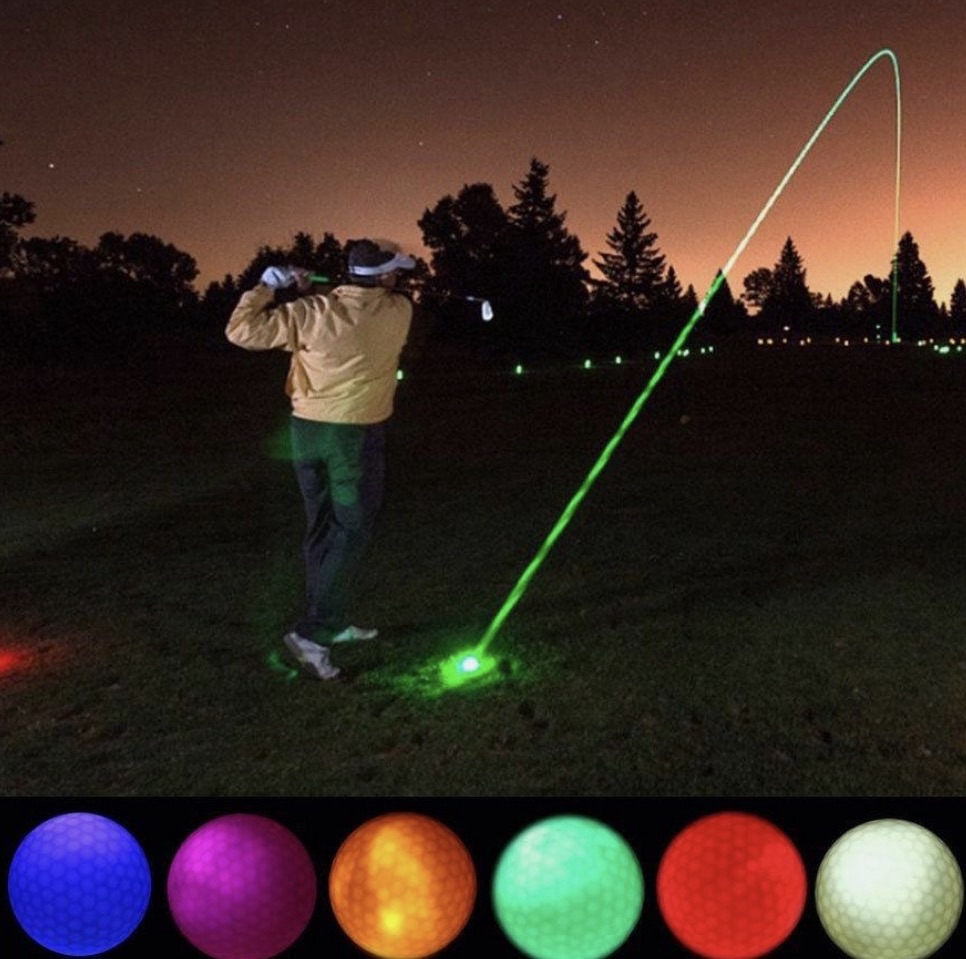
I’ve even seen caddies with headlamps and buggies around a green shining their headlights so that players can get finished.
But those are not really important to the usual amateur golfer.
Earlier in the week a group I play in had several mid-afternoon tee times. The course was very busy. Could we get finished? That was a very legitimate question! When will it be too dark to play?
But “when does it get dark?” is not really a question with a single answer, particularly if the question is being asked by a golfer who is trying to work out whether he can finish 18 holes.
Now some golf tee time booking systems (BRS for example) indicate to a user the tee-time 4 hours before sunset.
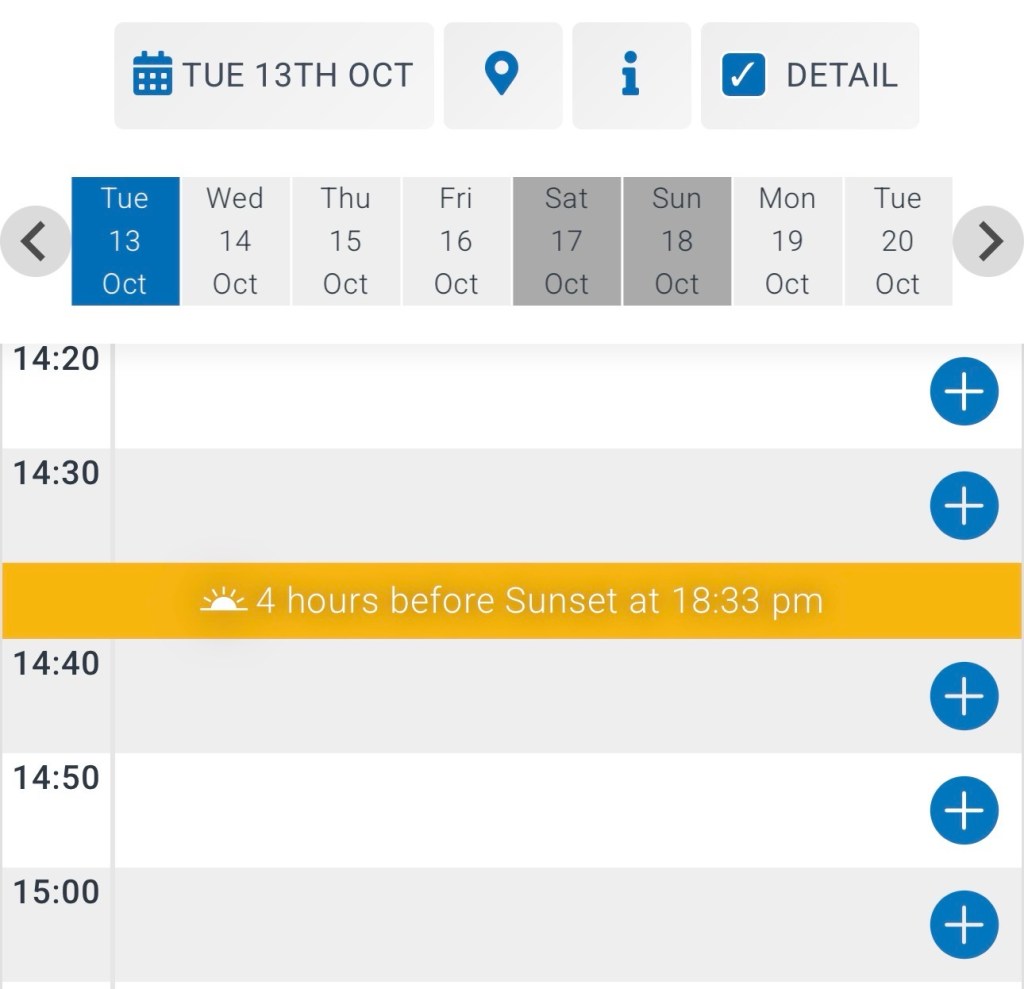
That’s perhaps a useful benchmark, but is certainly not the whole story. We need to think about twilight. It’s not just a word but a well defined period after sunset with three different categories.
Sunset and three different twilights
The important distinction is between sunset and the disappearance of useful light. They aren’t the same thing.
At sunset the Sun has merely reached the horizon. It does not suddenly switch off the illumination. The atmosphere continues to scatter sunlight into the sky, producing twilight.
Astronomers divide this into three stages according to how far the centre of the Sun is below the horizon. The boundaries are in some senses arbitrary but are reproducible and have been found to be useful.
- Civil twilight: from sunset to when the Sun is 6° below the horizon. There is still quite a lot of useful natural light and ordinary outdoor activities can generally continue without artificial lighting.
- Nautical twilight: the Sun is between 6 & 12° below the horizon. It is substantially darker; the horizon remains visible but artificial lighting is normally needed for ordinary outdoor activities.
- Astronomical twilight: the Sun is between 12 & 18° below the horizon. The sky is approaching true darkness, although the last traces of scattered sunlight remain.
Comparable periods are seen before dawn in the morning.
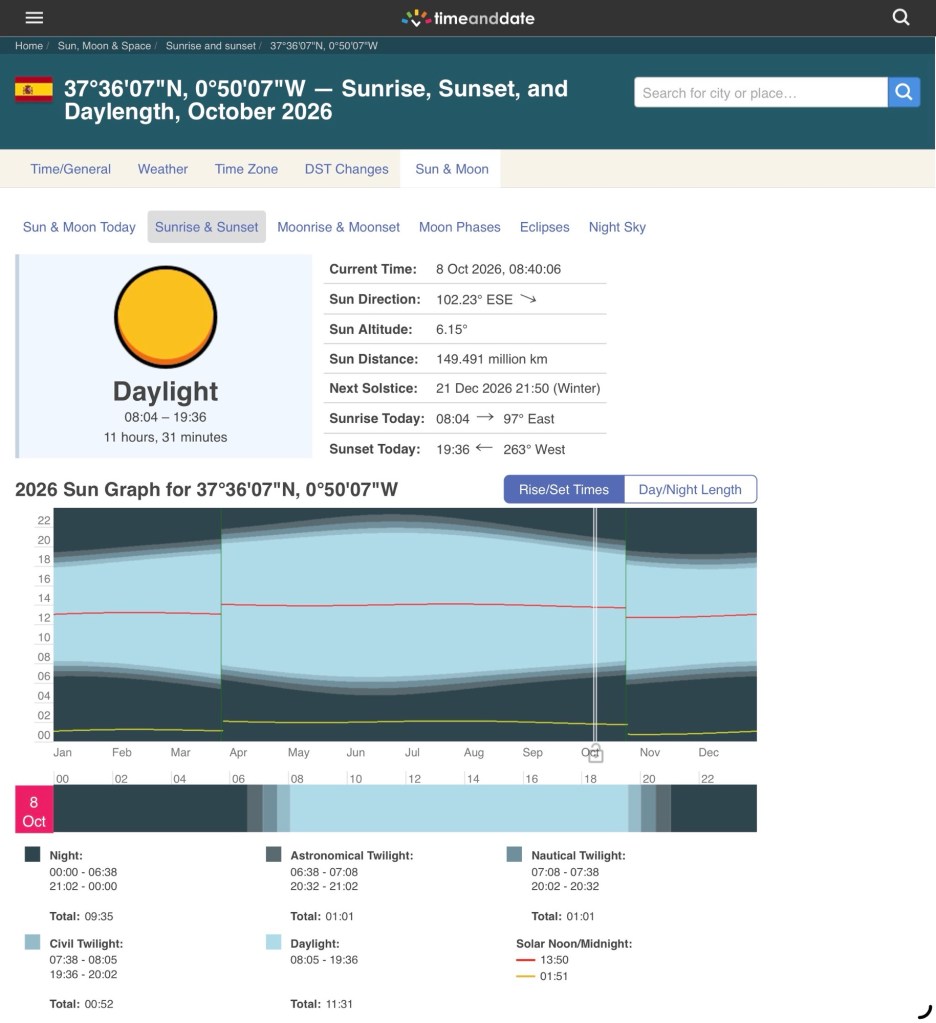
You can find the times of sunset (and sunrise) and the times and duration of the twilight periods from many websites. Time and date is my “go to”: it’s very easy to use.
Here is the output for the LaManga Golf Resort for 8th October 2026.
You also get a detailed numerical output as a Table, here for the nearby town of Los Belones, for each day of November.
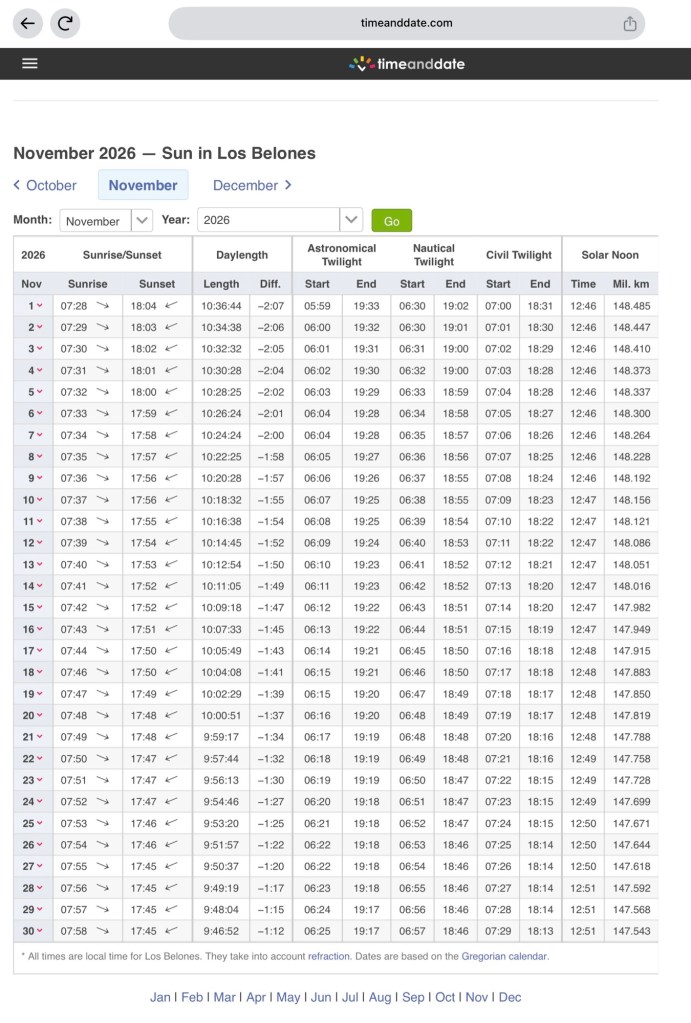
For a golfer that’s all rather abstract! None of those definitions quite answers the question.
The more relevant question is something like:
Can I still see the ball, judge its flight, find it in the rough and read a putt?
That is a rather different physical problem.
Why latitude matters
This is where it gets interesting. The Sun doesn’t necessarily plunge vertically below the horizon. Its apparent path depends strongly on latitude and the time of year.
It’s worth remembering that the sun moves 15° around its path in 60 minutes, although that path is at an angle to the horizon that depends on latitude of the observer. This influences the duration of the twilight periods.
Near the equator, the Sun can cross the horizon at a relatively steep angle. Consequently it gets below the horizon rapidly and darkness follows sunset quite quickly. At higher latitudes the Sun approaches the horizon at a shallower angle, so it takes longer to descend through the successive twilight zones.
So two golf courses at different latitudes could have exactly the same sunset time but very different amounts of playable light after sunset.
And there is another subtlety: latitude isn’t the whole story. The angle at which the Sun meets the horizon also varies with season and solar declination. This is why twilight can behave quite differently in summer and winter even at the same latitude.
There is a nice golfer’s way of thinking about it. Imagine the Sun descending through a series of invisible horizontal lines:
Horizon → 6° → 12° → 18° below horizon
Sunset is only the first line or time point. The golfer is really interested in somewhere between the first and second time points, depending on what he considers playable. After that it’s almost certainly too dark.
And “playable” isn’t a fixed astronomical quantity
This is probably the most interesting part of the question.
A golfer doesn’t need enough light merely to walk around a golf course. He needs enough contrast to distinguish a white ball from grass, see the landing area, identify hazards and trees, and judge distances. Putting is a particularly interesting final test because the ball may still be visible when the ability to read the contours of the green has deteriorated.
The direction of the final holes therefore matters too. A hole played towards the setting Sun can become difficult surprisingly early because of glare, whereas a hole played away from it may remain perfectly comfortable for considerably longer.
Trees and hills can also produce what might be called local sunset. Astronomical sunset is calculated for a level horizon, but if a hill or a line of trees blocks the western horizon, the Sun can disappear from the golfer’s view several minutes earlier. The US Naval Observatory points out that observer height, topography and atmospheric refraction can all affect the observed timing.
A further point is the changing efficiency of the retinal visual receptors as light intensity changes. The colour-sensitive cone cells lose sensitivity faster than the rod cells. Further there is some variation in individuals light perception with light intensity. But for this discussion we will assume that the golfers are of average visual ability.
So now that synthesis leads to what I think is the most useful formulation for golf:
There isn’t a “sunset time” at which golf stops.
There is a declining curve of available light, and the point at which golf becomes impractical depends on the course, the hole and the golfer.
Moreover on a bright cloudless day the factors we discussed are all at their maxima.
But on an overcast cloudy day obviously playing conditions deteriorate faster! Often much faster!
That suggests a much better way of answering the golfer’s question than simply giving sunset.
As a concrete example, today (8th October) in La Manga, rather than saying:
Sunset: 19:36
we could say:
- Sunset 19:36
- Civil twilight ends 20:02
and then add something like:
“In clear conditions, a golfer should normally have useful playing light during civil twilight, and so for perhaps another 15–25 minutes after sunset, but this may be course and cloud cover dependent.”
That last figure isn’t an astronomical definition, it is an empirical golfing judgement.
So if someone asks at 15:00, “Can we get round before dark?”, the answer cannot sensibly be obtained from the sunset time alone. We need to know
- how long the round will likely take,
- the latitude and the date, that dictate civil twilight, as well as
- the course orientation and topography,
- the cloud cover, and
- what we mean by “dark enough that I can’t play”, that’s a rather subjective assessment.
So what can we conclude?
As a rule of thumb, and for golfers of average vision, the end of civil twilight (that is easy to look up for any particular date and place) is probably a very much more useful datum than sunset.
The end of civil twilight should be your “go to” guide for determining how long you have left to play. Do not expect to be able to play beyond that.
Sunset is an astronomical event, whereas stopping play is a human visual threshold that, at least on a clear day, probably falls somewhere around the end of civil twilight.
On the other hand, perhaps you should try and get an earlier tee time!
If you found this post of interest please share it with others and subscribe to Craigavad golf
You may also be interested in Craigavad miscellany where I gently dive into mathematics, science, the natural world and other areas of interest.


A very topical and educational piece for golfers at this time of year . I was not aware of the 4 different sunsets ! or indeed that you could find websites for them . A most useful planning tool !!
LikeLike
Strictly they aren’t different sunsets but different levels of solar illumination. They have relevance in law especially in aviation and maritime law and in some jurisdictions in other contexts.
They all arose in astronomical observations. Specifically, since for astronomers the distinctions are operationally crucial.
During civil twilight, many stars are invisible and the sky background is bright.</
During nautical twilight, substantially more stars become visible, but the sky is still appreciably illuminated.
During astronomical twilight, the Sun is still sufficiently high below the horizon to contribute measurable sky brightness. Once the Sun reaches 18° below the horizon, astronomical twilight has ended and, in the conventional astronomical sense, true astronomical night begins.
This is why an astronomical observing programme might specify:
“Observations from the end of astronomical twilight until the beginning of astronomical twilight.”
It is a much more precise specification than “after sunset”.
LikeLike