Being a Commentator on live sport must be a truly hard occupation.
Forever trying to search for the right facts, accurate descriptions, knowledgeable and insightful comment, the right interpretation, sensible analogies and metaphors, effective turns of phrase, the avoidance of solecisms and truly awful faux pas. Few of us could do this in real time!
Most sports commentators are great, but even the very best can fail. Here is a particularly gross example . . .
I watch a lot of golf on TV. Probably far too much!
Many of the commentators on Sky, on The Golf Channel and other channels are truly fantastic. Kudos to them. Nick Doherty is a great anchor. “The American” Rich Beam is amusing, urbane and knowledgeable, and unusual in being an Europhile American golfer with a passport. Both Inci Mehmet and Iona Stephens have grown into their jobs and are really very effective and knowledgeable communicators.
But some just get to me! I’m going to generally avoid naming names. Some require me to turn the volume down. Perhaps because they can be rather repetitive in what they say and because they have “stock” phrases that are wheeled out far too regularly.
Maybe it’s my advancing years but I am possibly becoming a bit of a curmudgeon.
I’m going to focus on two big “crimes and misdemeanours”: one statistical and the other geometric. But let’s begin with a few phrases that can irritate.
“Five consecutive birdies, in a row”. So is that ten birdies then? It’s comical because the redundancy is so complete. It isn’t merely imprecise; it is a semantic duplication.
“Our leader!” No…. It’s The Leader! The possessive “our” is doing something rather odd. The leader isn’t ours. He or she is the leader of the competition. The commentator, the broadcaster and the viewer have no ownership whatsoever. Commentators seem to use “our” to create a sense of shared narrative: our player, our leader, our man on the 18th, our tournament. It makes the viewer feel part of the broadcast team. That’s probably harmless but it is imprecise.
It is remarkable how many times commentators misuse these terms: amount versus number…… a non countable quantity (for mass nouns or where things cannot be counted individually) versus a countable quantity (for plural nouns or tings that can be counted individually)! An amount of birdies? Nope, it’s countable so it’s a number of birdies.
Some commentators try to use words to sound clever but then really messing it up. Recently John E Morgan on Sky told us that a particular player, after a particularly good drive, was “dismembering the fairway” Really? Dismembering??
Bisect versus dissect! Sound similar but very different! Anthony Wall and John E Morgan are the most egregious miscreants but there are others! A player hits a great drive down the middle of a tight fairway. The commentator says “he’s dissected the fairway “! No he hasn’t! You would dissect a biological specimen in a lab to study its anatomy, or metaphorically dissect a financial report to analyze its inconsistencies. You would bisect a pie to share equal slices, or a major highway could bisect a town into two halves. Bisect has a geometric implication that might be relevant to a well struck drive. Dissect wouldn’t!
But those are arguably all rather trivial examples.
Here are the two things that are not trivial (well in my view!) and are my top two Commentary Misdemeanours.
Number 1: “The law of averages says this putt has to go in”
This is just nonsense and there is no such thing as a law of averages.
In the way sports commentators usually use it, “the law of averages” is a misleading, and simply wrong, description of probability.
Suppose a golfer has a 90% chance of holing a particular putt. If he misses it five times in succession, the next putt does not become more likely to go in. If the putts are independent and the circumstances are unchanged, the probability of holing the sixth remains 90%. There is no probabilistic mechanism saying, “You’ve missed five, so you’re due one.”
What is true is that, over a large number of attempts, the golfer’s proportion of successful putts will tend to approach the underlying probability. That’s the law of large numbers, not a “law of averages”. And importantly, it doesn’t require the misses to be compensated by subsequent makes.
For example, imagine tossing a fair coin. After ten consecutive heads, the probability of the next toss being tails is still 50%. But if you toss the coin another 10,000 times, the overall proportion of heads will tend to get closer to 50%. The earlier run of heads doesn’t get “corrected”; its influence simply becomes progressively less important as the sample gets larger.
There is an interesting wrinkle, though. Sometimes commentators are accidentally expressing something legitimate. Suppose a golfer normally holes 80% of ten-foot putts but has missed his last five. If those five misses provide evidence that our original estimate of his ability was wrong: perhaps he’s injured, the greens are unusually slow, or he’s simply putting badly today. Then our estimate of the probability of the next putt should change. But that’s Bayesian inference, not a law of averages.
And there is an even subtler statistical phenomenon behind some of the intuition: regression to the mean. If an athlete has an unusually poor run of performance, subsequent performance will often be closer to their long-term average. But again, this doesn’t mean that the universe is keeping score and requiring the athlete to make up the deficit. It happens because observations always contain an element of random variation.
So we can distinguish three things:
“He’s missed five, so he’s due to hole the next one.” The gambler’s fallacy. It’s not “a law of averages”. That’s a myth and is totally and utterly meaningless!
“Over many putts, his success rate will tend towards his underlying probability.” That’s the “law of large numbers”. A real statistical phenomenon.
“After an unusually bad performance, his next performance may be closer to his normal level.” That’s the statistical phenomenon of “Regression to the mean”.
The phrase “law of averages” is therefore particularly irritating to someone who has even a vague familiarity with mathematical thinking because it sounds as though it invokes a genuine mathematical law while actually smuggling in a total fallacy.
There isn’t a law which says that random events have to “even themselves out” in the short run. The “law of averages” simply doesn’t exist!
In fact, randomness produces runs, streaks and apparent patterns as a matter of course.
The mathematics of probability is rather more interesting than the commentator’s version of it.
Number 2: “The full 360! It is almost never even close to 360 degrees!”
A putt tracks towards the hole. It “lips out” and moves away from the hole. Maybe it turns almost back the way it was coming….. the commentator (typically – but not invariably – Sam Torrance) exclaims “… wow a 360” . Nope not even close!
Here is an unfortunate lip out by Lottie Woad. “A complete 360!” says the commentator. No it’s not! Nowhere even close!!
Here is a whole slew of unfortunate lip outs . . . but not one of them 360 degrees despite being all referred to as 360 degree lip outs!
Let’s look at the geometry …
Consider the ball tracking towards the hole. Let that the initial angle of path be 0 degrees. This is the datum from which all the angles are measured.
Let’s imagine the ball just clips the left edge of the hole and is slightly deflected. Perhaps by 30 degrees. Its path is now 30 degrees from the original path. (N.B. If the ball clips the right edge and moves to the left everything is merely reversed: the angular changes are the same).
Alternatively maybe there is more deviation. This time by perhaps by 90 degrees.
Or maybe a really strong lip out by more than 90 degrees and now the deviation might be (for example) 145 degrees.
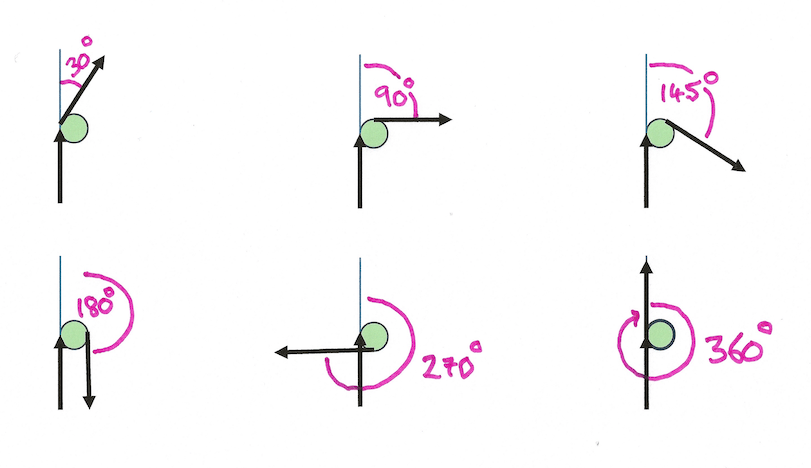
If the ball starts to come all the way back to you it has deviated by 180 degrees. Bizarrely this is frequently referred to as “a 360” when it’s actually just half of that!
Rarely the lip out turns a lot. Nearly all the way round the whole perhaps. That might be 270 degrees.
It happens but that’s really pretty rare!
Let’s be absolutely clear, only if it turns all the way around the hole and starts to run away from you in the direction it started has it actually gone through 360 degrees! This is very rare but does happen.
It seems that the majority of golf commentators have absolutely no understanding of the geometry of angles! It’s very basic and simple geometry and the failure to understand that is very irritating! 😠
Yes, I know, 🤷♂️🤦♂️ . . .
I’m definitely a curmudgeon!
But I’m sure you’ve other examples of Commentary Misdemeanours:
please add them to the Comments below.
If you found this post of interest please share it with others and subscribe to Craigavad golf
You may also be interested in Craigavad miscellany where I gently dive into mathematics, science, the natural world and other areas of interest.


