The Open is the oldest Major golf championship for men and the only one played outside the USA.
Let’s be very clear – the term British Open is not (despite what many Americans suggest) historically, geographically nor politically accurate as described in this very humorous piece. It’s played on links courses around the British Isles.
Here is a nice overview of the rota from Golf Digest and the ten current venues are shown on this map and this years venue is highlighted.
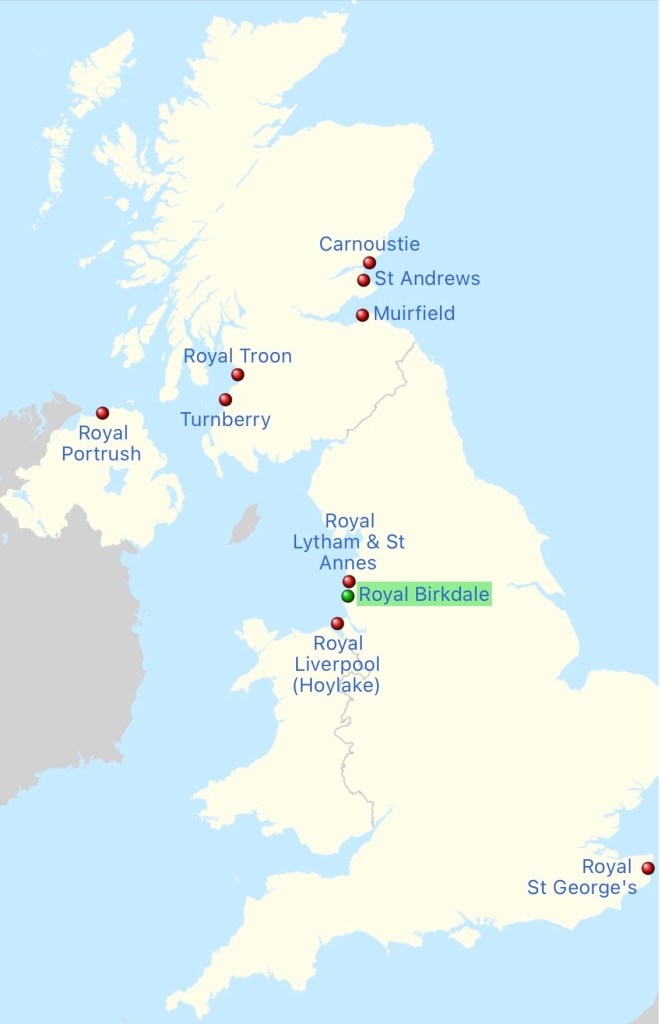
A range of other venues have been used in the past and Portmarnock to the north of Dublin may host The Open in the future.
The decision by The R & A as to which venues can host The Open is predicated on many factors, but road and rail infrastructure, availability of hotel rooms (and other accommodation) and space at the venue for required infrastructure are paramount: it’s not just the course! Why? It’s all about the economics!
The earliest Opens scarcely resembled today’s Championship. The inaugural Open at Prestwick in 1860 attracted perhaps only a few hundred spectators. There were no grandstands, no hospitality villages, no television rights, no overseas tourism and very little organised merchandising. Spectators simply gathered around the course as local people came to watch eight professionals compete over three rounds. The economic impact was modest and essentially confined to local inns, railway tickets and newspaper sales.
The Open has evolved through three distinct eras. Initially and even into the early twentieth century, it was just a golf tournament and attendance was modest. The Championship was prestigious within golf but had not yet become a mass spectator event.
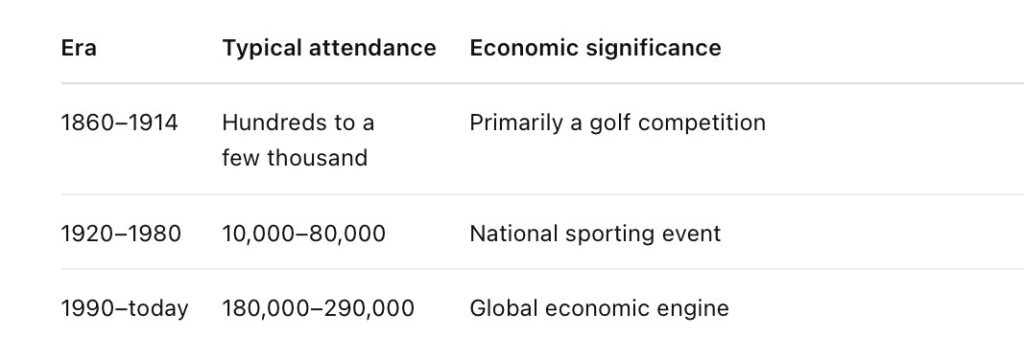
The first great transformation came after the Second World War. Improved transport, radio & television and growing prosperity steadily increased interest and crowds. By the 1970s and 1980s attendances were typically measured in tens of thousands rather than thousands. Golf’s popularity surged through players such as Arnold Palmer, Jack Nicklaus, Tom Watson and Seve Ballesteros, while the move to colour television brought the links to audiences around the world.
The second transformation has been even more dramatic. Over roughly the last thirty years The Open has become one of the world’s largest annual sporting events.
Here are some landmark data.
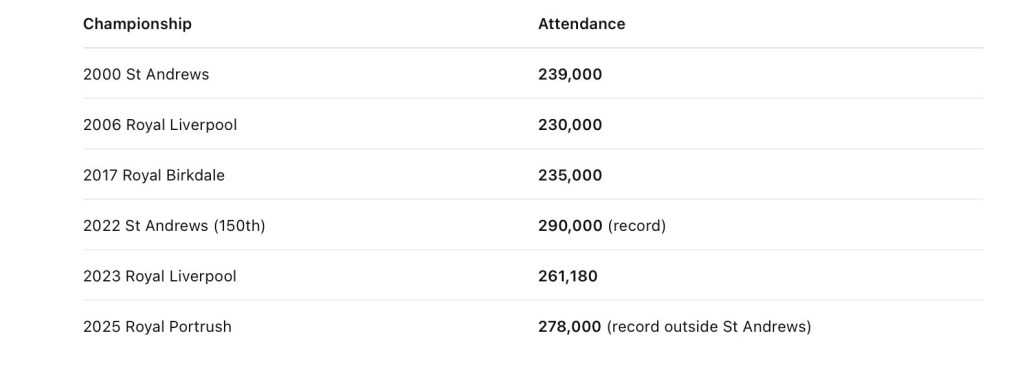
These numbers are astonishing. The Championship now attracts over a quarter of a million spectators in a single week, making it one of the largest annual sporting events in Britain. Three hundred thousand are expected at Royal Birkdale this week. Ticket ballots regularly receive well over one million applications, something unimaginable even thirty years ago.
The economic consequences have grown dramatically.
The 150th Open at St Andrews generated £106 million of direct economic impact (new money entering Scotland), £201 million in destination marketing value and £307 million total economic benefit.
The difference between today’s Championship and the Victorian Opens is therefore not a factor of two or even ten. It is probably a factor of many thousands. If one could somehow adjust for inflation and estimate the spending generated by the first Open in 1860, it might amount to a few thousand pounds in today’s money. Modern Opens generate hundreds of millions of pounds.
That remarkable growth reflects far more than increased spectator numbers. Each modern spectator typically stays several days, books accommodation, eats in local restaurants, hires cars, visits tourist attractions and often extends their holiday. Meanwhile hundreds of millions of television viewers receive what is effectively a week-long tourism advertisement for the host region.
In 1860, The Open was simply a golf tournament. Today it is still a golf tournament, but it is also an international broadcasting event, a tourism campaign, a cultural celebration and an economic catalyst. The golfers still compete for a silver claret jug, just as they did 166 years ago. Everything around them has changed almost beyond recognition.
There is a clear historical arc from local sporting contest to global economic phenomenon.
There are actually two different economic measures used by The R&A’s independent studies, and it’s worth distinguishing them:
- Economic impact – new money brought into the local or national economy through visitor spending (hotels, restaurants, transport, retail, etc.).
- Total economic benefit – economic impact plus the estimated value of global television exposure and destination marketing.
The second figure is much larger and is arguably more speculative, but it recognises that hundreds of millions of viewers are effectively watching a tourism advert for the host destination.
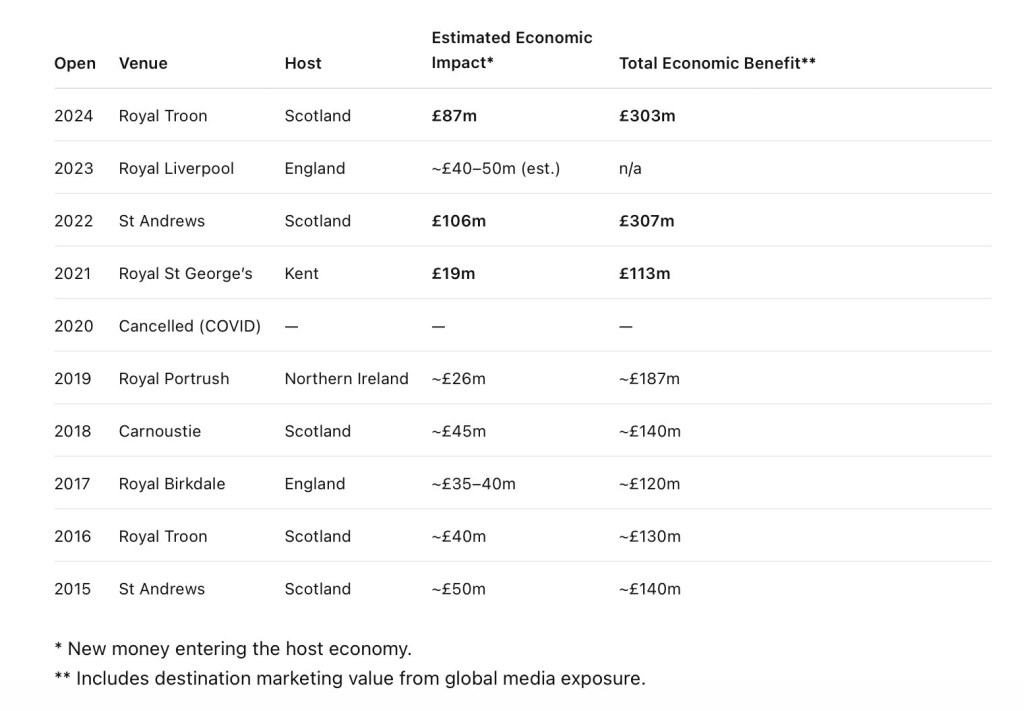
The strongest story, however, isn’t the individual tournaments. It’s the sustained growth.
Following the publication of the Royal Troon study, The R&A reported that the ten Open Championships staged in Scotland since 2005 have generated a cumulative economic benefit of approximately £1.36 billion. That averages around £136 million per Open when held in Scotland, although landmark editions such as the 150th Open at St Andrews and the 2024 Championship at Royal Troon exceeded £300 million in total economic benefit.
The Open lasts only four days. Its economic legacy lasts far longer. Hotels are filled, restaurants are booked, taxis run continuously, temporary jobs are created, and millions of television viewers are introduced to landscapes they may later visit. For Scottish venues, but also for all the other venues,
The Open is far more than a golf tournament.
It is a week-long economic stimulus package for its host region and, increasingly, a global marketing and tourism campaign for the host region.
This is the first of an occasional series entitled
‘More than a game”
on the economics of golf.
If you found this post of interest please share it with others and subscribe to Craigavad golf
You may also be interested in Craigavad miscellany where I gently dive into mathematics, science, the natural world and other areas of interest.


2 thoughts on “More Than a Game 1: The Economic Impact of The Open”