Golf has a curious relationship with the word “green”.
The game is played on greens. Players speak of keeping the ball on the green, reading the green and reaching the green in regulation. Golf clubs take pride in presenting immaculate expanses of green grass. The colour is so deeply woven into the sport that it has become part of its identity.
Yet in recent years the word has acquired a second meaning. To be green is to be environmentally responsible. It is to reduce emissions, conserve resources and minimise our impact on the planet. As concerns about climate change and sustainability have moved from the margins to the mainstream, almost every human activity has come under scrutiny. Aviation, agriculture, transport, energy generation and manufacturing have all been examined through an environmental lens.

Golf has not escaped that examination.
At first glance the verdict appears obvious. Golf courses occupy large areas of land. They require maintenance, machinery, fertilisers and water. Professional tournaments involve international travel. Golf tourism sends millions of people around the world in pursuit of famous courses. The image of emerald-green fairways in the middle of arid landscapes has become a familiar target for environmental criticism.
But as is often the case, the closer one looks, the more complicated the picture becomes.
The question “How green is golf?” turns out to be rather like asking whether a car, a house or a holiday is environmentally friendly. The answer depends not only on what it is, but on how it is used.
For most golfers, the largest environmental impact may have little to do with golf itself.
Consider a typical Saturday morning round. A golfer drives twenty or thirty miles to the course, plays eighteen holes, perhaps has lunch in the clubhouse, and drives home again. The emissions associated with the journey may well exceed the golfer’s share of the course’s maintenance footprint for that day. The same round played by someone who walks to a nearby club or cycles there has a very different environmental cost.
This is a recurring theme in environmental discussions. We often focus on the obvious object while overlooking the wider system in which it operates.
The golf course as an environmental problem
A standard eighteen-hole course may occupy well over one hundred acres. To some critics this is self-evidently wasteful. Land is a finite resource, particularly near towns and cities. Why should such large areas be devoted to a recreational activity enjoyed by a relatively small number of people?
Yet land use is rarely so straightforward. What matters is not simply how much land is used, but what alternative uses are available.
The game’s oldest courses offer an interesting lesson. The great links courses of Scotland and Ireland were not designed by environmental consultants, yet they evolved in a manner that would today be regarded as highly sustainable. The very name is important. Links courses developed on land that “linked” the seashore and fertile and useful land. They were on land that had little real value. They were shaped by wind, sand, grazing animals and the natural contours of the land. Irrigation was unnecessary. Artificial fertilisers were unknown. The landscape dictated the golf rather than the other way around.
A golf course built on ancient woodland or species-rich habitat may represent an environmental loss. A golf course preserving open green space on the edge of a city may prevent that land being covered by roads, warehouses or housing developments. In many urban areas golf courses form some of the largest continuous areas of undeveloped land remaining within easy reach of population centres.
Indeed, many golfers would be surprised to learn how little of a course is actually maintained for golf. Greens, tees and fairways occupy only a fraction of the total area. The remainder consists of rough grassland, woodland, ponds, wetlands and semi-natural habitat. Whether these areas become ecological assets or ecological deserts depends largely on how they are managed.
Historically, golf often pursued an aesthetic of control. Trees were planted where none had existed. Rough areas were cut back. Vegetation deemed untidy was removed. Chemicals were used to maintain consistent playing conditions. The ideal course was neat, manicured and predictable.
Modern environmental thinking increasingly points in the opposite direction.
Many clubs now recognise that biodiversity and playability are not necessarily enemies. Rough grasslands can support insects and birds. Wetlands can provide habitat while also helping manage floodwater. Native vegetation often requires less maintenance than imported species. In some cases environmental stewardship and reduced costs align remarkably well.
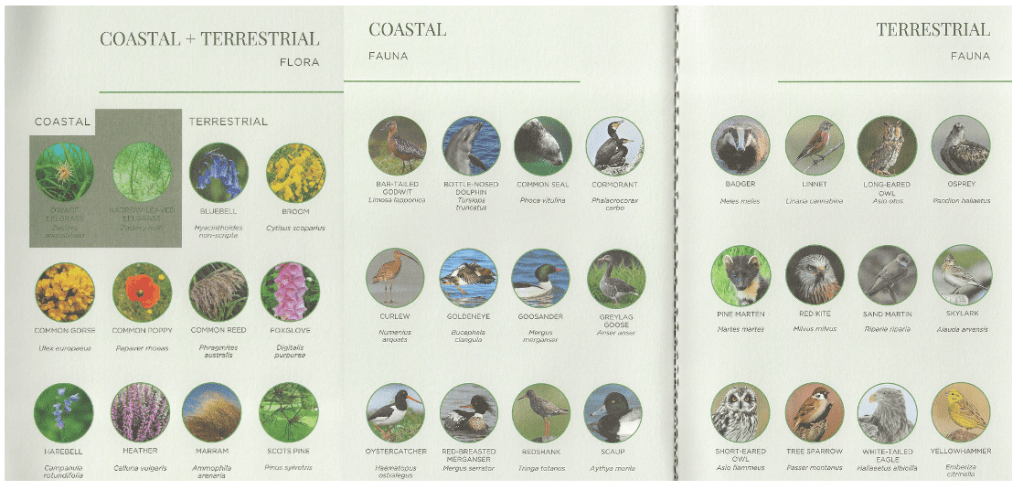
Consider the new courses near Inverness at Cabot Highlands. The designers and owners have gone to huge lengths to ensure sustainability and fostering of the flora and fauna of the area. Their materials are hugely educational as well. Surely the way forward.
The problem of water
The issue of water perhaps presents golf’s greatest environmental challenge.
In the British Isles, where rainfall is abundant, golfers often take water for granted. A dry summer may produce brown fairways and worried greenkeepers, but the game has evolved in a climate where nature generally provides what is needed.
Elsewhere the situation can be very different.
The sight of lush green fairways in desert environments raises an obvious question. If a landscape naturally supports cacti and scrub, how much energy and water are required to maintain acres of pristine turf? Is it sensible to create artificial oases in regions where water is already scarce?
The answer again depends on the details. Some courses rely heavily on freshwater resources. Others use recycled wastewater that would otherwise be discarded. Some have dramatically reduced irrigated areas, allowing large sections of the course to revert to native vegetation. Technological improvements have made irrigation systems far more efficient than those of previous generations.
A recent study provides insight into the complexity of the water issue. Rodriguez and colleagues from The Agricultural Research Centre in Córdoba and the Centre for Water Science, Cranfield University, undertook a detailed survey of golf course irrigation practices in Spain, and specifically the competing demand for water between golf and agriculture.
Using a geographical information system (GIS), the water consumption for all golf courses in Spain was modelled and mapped, and the total water consumption estimated. The results show that the volume of water used for golf irrigation is extremely small compared to agricultural irrigation. Furthermore, a significant portion comes from wastewater reuse (41%) and desalination (7%), rather than direct abstraction, which competes with agriculture.
As always interpreting data depends on perspective. Certainly the Murcia region of Spain golf provides considerable high value employment and income. Agriculture is hugely important but is per unit area a much lower income generating activity.
Taken together the data suggests that irrigating golf courses for tourism purposes is an economically rational water use in Spain. Perhaps not what some might have predicted. Nevertheless, the underlying tension remains. As climate change places increasing pressure on water supplies, golf will face growing scrutiny in regions where water scarcity is becoming a defining issue.
Professional golf & golf tourism
This introduces another dimension. The environmental footprint of an individual golfer may be relatively modest. The footprint of global professional golf is considerably larger.
Modern tours are international enterprises. Players, caddies, officials, broadcasters, sponsors and spectators travel immense distances. Equipment is transported across continents. Temporary infrastructure is erected and dismantled week after week. The carbon emissions associated with this global movement inevitably attract attention.
Yet golf is hardly unique in this regard. Modern sport in general has become an international industry. Football clubs criss-cross Europe. Formula One circles the globe. Tennis players move from continent to continent throughout the season. The challenge facing golf is one shared by many sports: how to reconcile global competition with a world increasingly conscious of carbon emissions.
Perhaps nowhere is this dilemma more apparent than in golf tourism.
The game possesses a remarkable geography. Golfers dream of playing famous courses in Scotland, Ireland, California, Australia or New Zealand. Entire tourism industries have developed around these aspirations. For many people, a golfing pilgrimage to St Andrews or Royal County Down represents a lifelong ambition.
Yet from an environmental perspective such journeys are difficult to ignore.
A single transatlantic flight may generate more carbon emissions than years of local golf. The irony is striking. A golfer who walks every round, carries a lightweight bag and supports environmental initiatives at home may nevertheless generate a substantial carbon footprint through occasional long-distance golf travel.
This does not make such travel inherently wrong. It merely highlights the complexity of balancing personal enjoyment, cultural experience and environmental responsibility. The same dilemma confronts anyone who travels for leisure, whether to play golf, visit historic sites or simply experience another part of the world.
What can we conclude?
What emerges from all of this is a picture that resists simple conclusions.
Golf is neither the environmental villain portrayed by some critics nor the inherently sustainable activity described by its most enthusiastic defenders. Like many human pursuits, it exists on a spectrum.
A heavily irrigated resort course in a water-stressed region presents one set of environmental challenges. A traditional links course requiring minimal intervention presents another. A golfer who regularly flies around the world has a different footprint from one who walks a local course every weekend. To speak of golf as though it were a single environmental entity is to overlook these important distinctions.
Perhaps the most interesting question is not whether golf is green today, but whether it can become greener tomorrow.
There are reasons for optimism. Advances in turf management are reducing chemical use. Electric maintenance equipment is replacing diesel machinery. Biodiversity projects are becoming increasingly common. Water management is improving. Designers are paying greater attention to natural landscapes and native species. Many clubs now see environmental stewardship not as a public-relations exercise but as a practical necessity.
In a curious way, the future may involve rediscovering aspects of golf’s past.
The game’s origins lay not in engineered landscapes but in working with nature. The earliest golfers adapted to the terrain they found rather than reshaping it to suit their preferences. Brown patches were accepted. Uneven bounces were expected. Weather was not an inconvenience but an integral part of the challenge.
As the twenty-first century progresses, golf may find itself returning to some of those principles.
The word “green” has always occupied a central place in the game. The challenge now is ensuring that the two meanings of the word can coexist. Golf will undoubtedly continue to require land, water and resources. The question is whether it can do so in a manner consistent with a society seeking a more sustainable future.
The answer is unlikely to be found in slogans or simple judgments. It will emerge course by course, club by club and golfer by golfer. Like many of the most important questions of our time, it is less about choosing between black and white than navigating the many shades of green in between.
If you found this post of interest please share it with others and subscribe to Craigavad golf
You may also be interested in Craigavad miscellany where I gently dive into mathematics, science, the natural world and other areas of interest.


