This week will see the 126th US Open at Shinnecock Hills Golf Club, 90 miles from New York on the eastern end of Long Island.
One hundred and fifty six players including twenty amateurs will tee up on this fantastic 7440 yard par 70 layout.
One of the truly great courses of North America. Hilly and with the wind sweeping of the sea. Almost a true links, built on sand, close to the sea, usually windy and always a challenge.
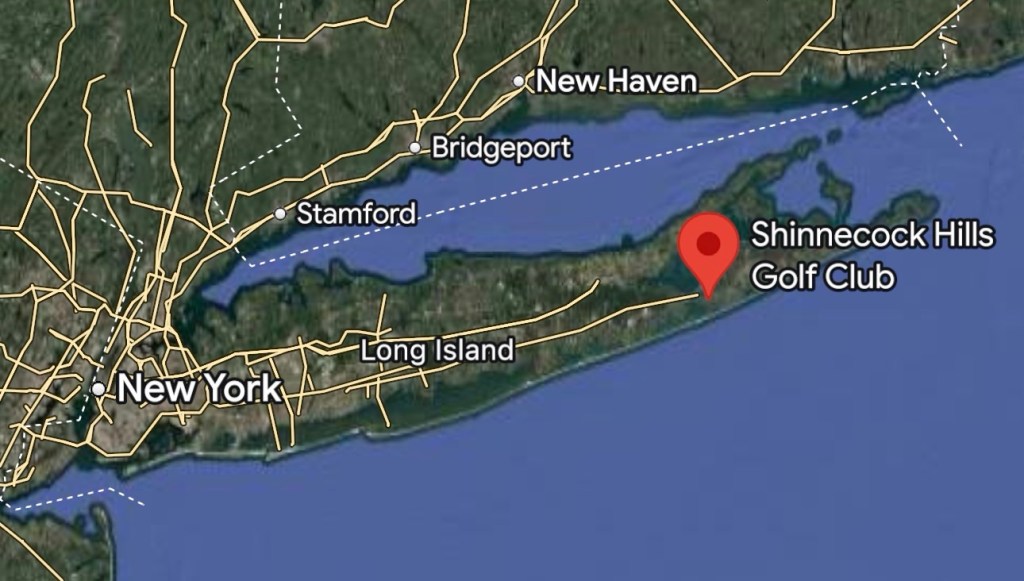
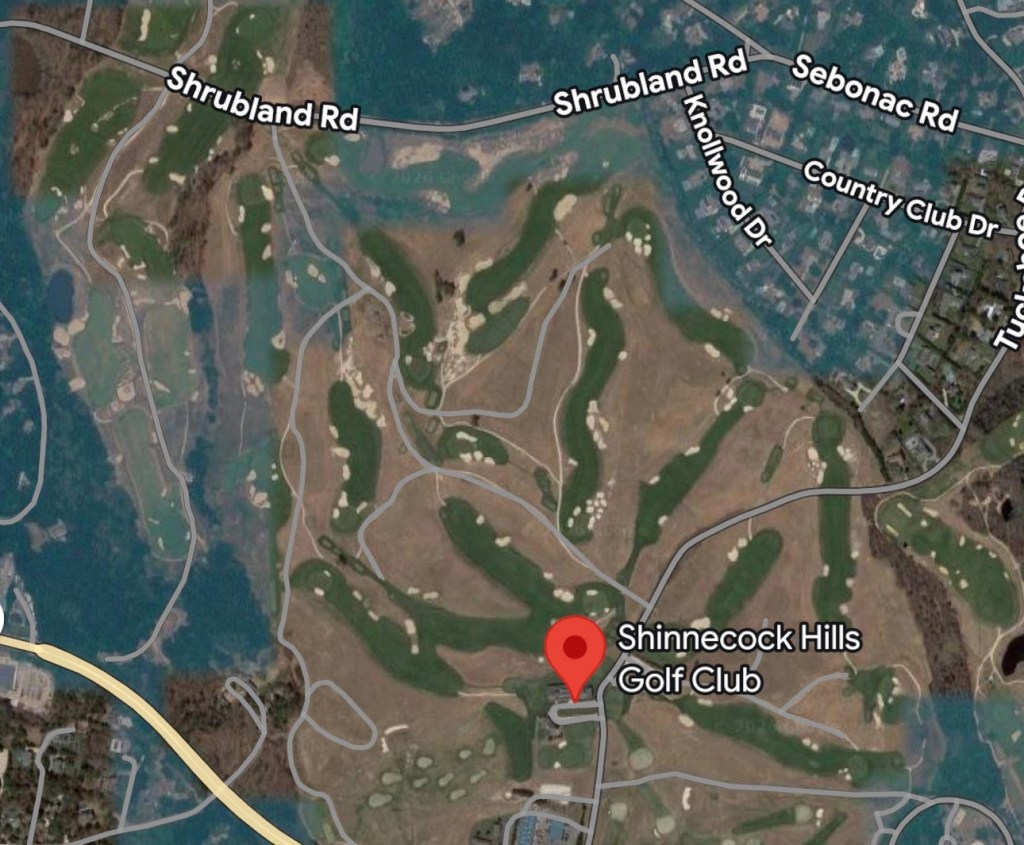
Shinnecock has hosted the US Open on five prior occasions (1896, won by James Foulis, 1986, won by Raymond Floyd, 1995 won by Corey Pavin, 2004 won by Retief Goosen and in 2018 won by Brooks Koepka).
The 2004 US Open at Shinnecock was incredibly controversial and the last US Open in 2018 also had controversy!
The 2026 US Open returns to Shinnecock Hills on Thursday. Let’s discuss this great layout and why the last two stagings of the US Open at this fantastic venue have been so controversial.
We should begin with a little history.
A very brief history of golf at Shinnecock Hills
Shinnecock Hills Golf Club occupies a unique place in golf history. Founded in 1891 on Long Island, it is the oldest golf club in the United States and one of the five clubs that established the United States Golf Association in 1894. Shinnecock Hills is consistently ranked among the world’s finest golf courses.
The original 12-hole course was designed by Scottish professional Willie Davis. As golf rapidly gained popularity in America, the course was expanded to 18 holes in 1895. During its early years, Shinnecock reflected many of golf’s Scottish traditions, including a links-style character created by the open, rolling terrain and exposure to strong coastal winds.
The club played an important role in broadening participation in American golf. Women were admitted from the beginning and had access to the course and clubhouse, an unusual policy for the period. Shinnecock also became associated with John Shippen, who in 1896 became one of the first Black and Native American golfers to compete in the U.S. Open. Seemingly the British contingent of professionals were going to boycott the event because of this but relented at the 11th hour! Shippen played and finished respectably, later becoming a significant figure in golf history.
The course seen today is largely the work of renowned architect William Flynn, whose major redesign opened in 1931 (a redesign needed because of a new road being built through the original layout!). Flynn’s layout blended naturally with the landscape and is widely regarded as one of the greatest golf-course designs ever created.
It has hosted many important events, for example the 1896 U.S. Amateur (H.J. Whigham), the 1900 U.S. Women’s Amateur (Frances Griscom), the 1967 U.S. Senior Amateur (Ray Palmer), and the 1977 Walker Cup (USA).
Shinnecock Hills hosted the second US Open in 1896 and is unique in having staged the US Open in three different centuries. The course is renowned for its demanding greens, strategic bunkering, and the challenge posed by wind, often producing some of the sternest tests in championship golf. Indeed in the previous Open’s only three players have scored better than par: just three!
2004 US Open at Shinnecock Hills
The 2004 U.S. Open at Shinnecock Hills Golf Club has become one of the defining examples of a championship setup crossing the line from “extremely difficult” to arguably “completely unfair.”
This was perhaps one of the most controversial US Opens!
It was carnage! Absolute carnage!!
You can look at the scores for all four rounds here. The average score in the par 70 layout was over 78. Over the weekend scores well into the 80s were common!
In a recent Golf Digest podcast “The 50 Things That Changed Golf”, the excellent Shane Ryan and Jamie Kennedy provide an comprehensive overview of, not only the 2004 championship, but the historical context. It’s a great listen, as are others in this series.
The irony is that the tournament began quite normally. After two rounds, several players were under par, with Phil Mickelson and Shigeki Maruyama leading at six under. The USGA, concerned that scoring was too low for a U.S. Open, allowed the course to become progressively firmer and faster over the weekend.
There is disagreement as to who instructed greens staff to double cut and double roll the greens. Then the weather intervened. Strong sun, wind, and Shinnecock’s naturally sandy soil combined with the aggressive setup to produce greens that became almost impossible to hold.
By Sunday, the 7th green was the epicentre of the controversy. Well-struck shots would land on the putting surface and roll off. Players watched short putts and chips trickle away uncontrollably. Officials eventually did something almost unheard of in a major championship: they watered the green during play, between groups. Photographs of greenkeepers standing with hoses became the enduring image of the championship.
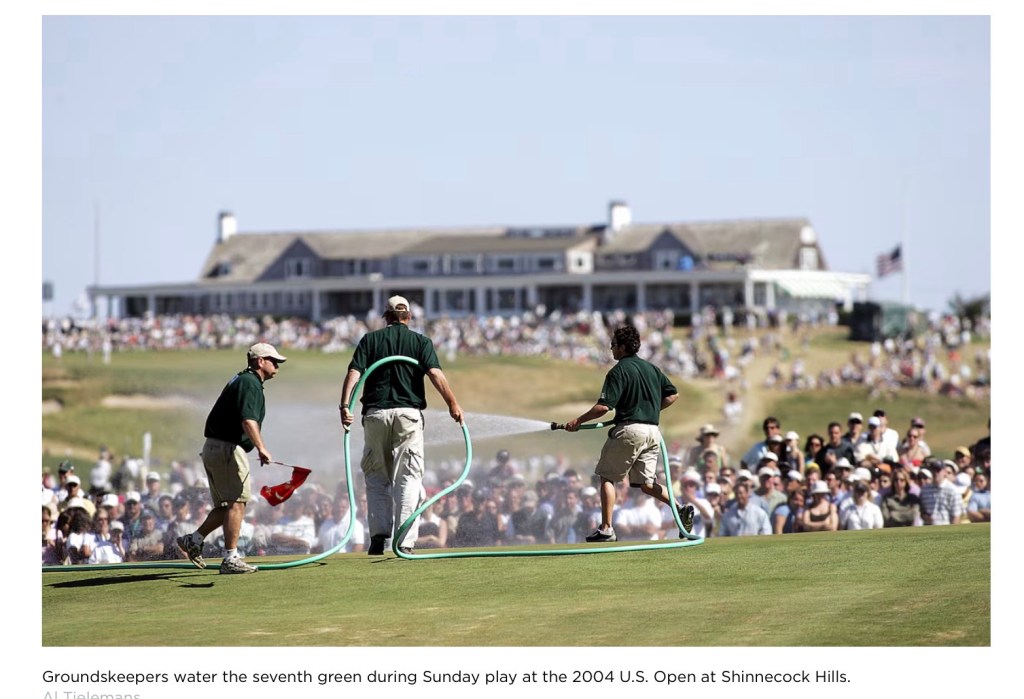
The statistics were extraordinary. No player broke par in the final round. The average score was 78.7, nearly nine shots over par. There were dozens of rounds in the mid 80s! Many competitors felt that good shots were no longer being rewarded and that luck had become too large a factor.
If you’re feeling brave here is the whole final round on YouTube. Carnage! It should come with a warning – it’s really scary!
Here is a marvellous contemporary critique of the events at the 2004 US Open by Geoff Shackleford. Just one page: it’s well worth reading.
What makes the story fascinating is that one player seemed almost immune to the chaos: Retief Goosen. While everyone else was struggling merely to survive, Goosen produced a masterclass in patience and touch. Perhaps one of the more impressive examples of a player’s temperament matching the demands of a championship.
Several factors worked in his favour.
First, Goosen had perhaps the ideal putting stroke for those conditions. The greens were extremely fast, firm, and unpredictable. Players who relied on an aggressive, “hit-it-firm” style of putting struggled badly. Goosen was renowned for a smooth, rhythmic stroke that allowed him to die the ball into the hole. When everyone was terrified of three-putting, he looked comparatively comfortable.
Second, his entire game was built around control rather than attack. Many players attempted to force birdies or recover aggressively after mistakes. Goosen accepted that par was an excellent score. He rarely chased pins and was content to play to the safest part of the green. At Shinnecock, that strategy paid enormous dividends.
Third, he possessed an unusually calm temperament. He appeared almost unemotional under pressure. The course was frustrating players into anger and rash decisions, but Goosen’s pulse seemed barely to rise.
A fourth factor was his ball flight. Goosen’s compact, repeatable swing produced a penetrating trajectory that coped well with the wind. Shinnecock’s exposed location means that controlling distance is often more important than sheer power. He ranked among the best iron players in the world at the time.
The most remarkable statistic is his final round. While the field averaged nearly 79, Goosen shot 71. He did not play brilliantly in the conventional sense: he simply made far fewer mistakes than everyone else. On a day when bogeys were inevitable, he avoided doubles and triples. In U.S. Opens, especially at Shinnecock, that is often the difference between winning and disappearing down the leaderboard.
The conditions at Shinnecock exposed weaknesses in many players’ games, but they highlighted Goosen’s strengths: patience, precision, and emotional control.
Goosen was serene while everyone else suffered mightily in the difficult conditions, made unbelievably worse by the USGAs abject failure to control the course!
The 2018 US Open at Shinnecock
Perhaps one of the most critiqued individuals at the 2018 Open was Mike Davis. Bizarrely he was in that position because so many of the USGA officials lost their positions because of what happened in 2004! He became the USGA Director of Rules and Competitions in 2005, in the aftermath of the Shinnecock debacle, when many USGA staff “moved on”. From then he was responsible for course setup, most visibly for the US Open. He was in charge for the 2018 Open and in its aftermath he got beat up!
Phil Mickelson was perhaps the biggest looser of 2018. He had come second in 2004 and had suffered from the conditions that Goosen had survived. Indeed he has come second in the US Open on six occasions and it’s the only major he needs for the career Grand Slam. He famously lost his sense of humour while putting on the slick greens! Having misjudged a put on the slick 13th green: he ran past the hole hitting the moving ball and incurring a 2 shot penalty on his way to an 8! You can see it here:
Given his experiences in 2004 his actions, while reprehensible, were perhaps understandable. Nevertheless he was “roasted” by the golfing media! A Golf Digest report is here and is very interesting reading.
Unlike 2004, the course was not out of control for the entire weekend. For much of the tournament it was exactly what the USGA wanted: fast, firm, windy, and extremely demanding. Scores were high from the start, and players had to think their way around the course rather than overpower it.
The trouble came on Saturday afternoon. Strong winds and drying conditions made some greens excessively severe. Early starters such as Tony Finau and Daniel Berger shot 66, while players in the later wave faced much tougher conditions. Dustin Johnson began the day with a four-shot lead but shot 77. Players complained that good shots were not holding greens and that the course had become dependent on luck. Zach Johnson famously said, “They’ve lost the golf course.” The USGA subsequently admitted it had pushed the setup too far and softened conditions for Sunday.
Lost in all the drama was an outstanding performance by Brooks Koepka. He had won the US Open the previous year at Erin Hills, a course where players made birdies in bunches. Shinnecock was the complete opposite. Yet Koepka won there too, demonstrating that he could succeed under entirely different conditions. He finished at one over par, the first U.S. Open champion to finish over par since 2013, and became the first player since Curtis Strange to win back-to-back U.S. Opens.
The long term impact of the 2004 US Open
The 2004 championship did not immediately cause a wholesale purge of USGA leadership. Key figures such as Walter Driver (chairman of the championship committee at the time) remained influential, and later became USGA president. But internally the event triggered a major reassessment of how the US Open was prepared and managed.
The USGA’s reputation took a substantial hit. For years afterward, virtually every controversial US Open setup was compared to “Shinnecock 2004.” The organisation conducted a thorough review of its procedures and eventually developed a formal course-setup philosophy document to guide future championships. That was a direct consequence of what happened at Shinnecock.
In many ways the biggest change was cultural. Before 2004, the USGA often seemed obsessed with defending par and proving that the US Open was golf’s toughest test. After the failure to keep control of the course Shinnecock, there was increasing recognition that the objective should be fairness rather than simply high scores. That evolution continued over the next decade and is still evident in the USGA’s current philosophy of “letting the course be the course” rather than forcing it to the edge of playability.
As Geoff Shackleton wrote:
“the USGA survived the 2004 Open, but it never quite escaped it”.
Let’s hope that this years US Open on the fantastic Shinnecock layout is a great event and the unfortunate events of 2004, and to some extent 2018, are not repeated: certainly some are optimistic as Iain Carter writes in this comprehensive piece!
Postscript
Earlier I made reference to Geoff Shackleford’s short, pithy and accurate critique of the USGA’s failures at the 2004 US Open. Let’s look at one small passage of his commentary.
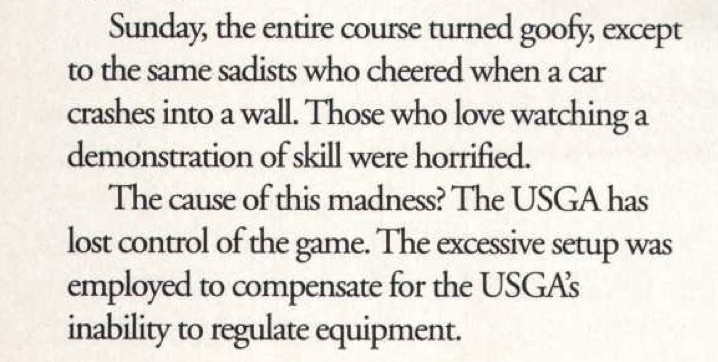
Look at the final sentence: “The excessive setup was employed to compensate for the USGA’s inability to regulate equipment”.
This was written 22 years ago! Even then, in the very year that the USGA and The R&A limited (!) the size of driver heads to 460 cc, respected observers (such as Shackleton) were already saying that the authorities were failing the game by not regulating the rampant improvements in equipment.
This of course comes back to last weeks Craigavad golf blog on the abject failure that will be the “golf roll back”.
I think Shackleton’s comments from 2004 underscores the arguments I made that the guardians of our game were “asleep at the wheel” and arguably negligent!
If you found this post of interest please share it with others and subscribe to Craigavad golf
You may also be interested in Craigavad miscellany where I gently dive into mathematics, science, the natural world and other areas of interest.


The powers that be have not only failed to regulate equipment, they have introduced a flawed World Handicap system and that have perpetuated segregation by gender rather allow the handicap system to let us all play together
LikeLike
Thank you.
I’ve written about the failings of WHS previously. It really does have failings… but where I play in Spain (LaManga Club) both genders play together without any real issues. Gender neutral competitions are common.
In contrast in Northern Ireland where I play in the summer there are no mixed gender competitions. So I’m not convinced that this is one of the major issues of WHS per se rather than a cultural issue! Not sure we can blame WHS for this…. 🤷♂️
LikeLike