There are many mysteries in golf. Why a perfectly struck drive sometimes finds a bunker, why a putt that looks certain to drop somehow finds the lip, and why a ball which has apparently cleared every conceivable obstacle manages to end up behind the one tree in the vicinity. These are familiar frustrations. But there is another, rather more modest phenomenon, which deserves a little scientific attention: what happens to the humble tee peg immediately after the clubhead has launched the ball on its journey.
My attention has been drawn to this seemingly arcane topic by David Brophy of Malahide and La Manga who recently asked me:
Why do golf tees fly in different directions on your tee shots? Is there a guaranteed flight pattern for the tee if you swing a certain way. Forwards, backwards or sideways? I was pondering this today as peoples tees were going every which way.
I had never really paid any attention to this conundrum, although I vaguely recall someone suggesting that with a well struck shot the tee goes back behind you.
Nevertheless, anyone who has spent time watching or playing golf will have noticed that tee pegs have a remarkable capacity for independent travel. Some disappear forwards towards the target, others fly backwards towards the golfer, while a surprising number depart sideways, apparently with no particular regard for the direction of the swing. Occasionally one remains standing, looking rather pleased with itself, having survived the entire operation.
So the underlying question is whether these apparently random movements are genuinely random or whether there is an underlying mechanical explanation.
At first sight, one might assume that the direction of the tee is determined by the direction in which the clubhead is travelling. An in-to-out swing might be expected to send the tee one way, an out-to-in swing another, and a relatively straight swing to produce a more predictable forward or backward movement. Unfortunately, the physics is not quite so obliging. The clubhead is travelling in three dimensions, with horizontal, vertical and rotational components, and the precise point and angle at which it contacts the tee are likely to be important. The force imparted to the tee need not be in the same direction as the clubhead’s overall movement. Of course the size and shape of the club-head will also be relevant.
There is also the question of the tee itself. Not all tee pegs are created equal. Traditional wooden tees, plastic tees, bamboo tees and the more flexible varieties will have different mechanical properties. Their stiffness, elasticity, damping characteristics and resistance to fracture will influence how they respond to impact. A wooden tee may bend slightly before breaking, whereas a flexible plastic tee may deform considerably and then recover its shape. A rubber tee, by contrast, may absorb much of the energy through deformation. In mechanical terms, we are dealing with differences in Young’s modulus, bending stiffness, energy dissipation and, potentially, fracture strength.
The geometry of the tee is equally relevant. Its length, diameter, taper and cross-sectional shape all influence its resistance to bending. For a simple cylindrical beam, bending stiffness depends on the fourth power of its diameter. A relatively small change in diameter can therefore produce a surprisingly large change in stiffness. The length of the unsupported portion of the tee is also important, since bending stiffness varies inversely with the cube of its effective length. These are not insignificant considerations when attempting to understand why two apparently similar tee pegs might behave quite differently.
But perhaps the most neglected element in this little puzzle is the ground itself.
A tee peg is not initially a free body. It is embedded in turf and soil, and the resistance offered by the ground may be just as important as the properties of the tee. How deeply has it been inserted? Is the soil firm and compacted, soft and damp, or loose and sandy? How much friction exists between the tee and the surrounding soil? How readily does the ground deform when the tee is subjected to a lateral force? All these factors are likely to influence whether the tee bends, rotates, pulls out of the ground, breaks or undergoes some combination of these processes.
A deeply embedded tee in firm ground will generally experience greater restraint than a shallowly inserted tee in loose soil. This may cause it to bend more substantially before being released, or perhaps to fracture rather than emerge intact. Conversely, a shallowly inserted tee may be dislodged relatively easily. Moisture complicates matters further: wet soil may offer less resistance in some circumstances, but adhesion and suction can also influence the force required to extract an embedded object.
This is all beginning to sound like a problem in geo-mechanical engineering, and indeed there are established mathematical approaches for studying the behaviour of piles and other structures embedded in soil. Such approaches could potentially be adapted to a much smaller and more transient problem such as a golf tee peg.
The actual impact introduces another layer of complexity. The clubhead, ball and tee are interacting over an extremely short period of time. The tee may be struck directly by the clubhead, caught by a glancing contact, displaced by the departing ball, or released as a consequence of its own bending and subsequent recovery. The forces involved are brief but potentially substantial. The appropriate mathematical framework would therefore involve impulse and momentum, rather than simply considering the static forces acting on the tee.
The direction of the resulting velocity will depend on the direction of the net impulse, which in turn reflects the clubhead contact, the deformation of the tee and the reaction of the ground. Once airborne, the tee becomes a projectile, subject to gravity and air resistance. Its initial velocity vector determines its subsequent trajectory that may have rotational components.
There is a lot of potentially complex physics in this problem.
So where does all this discussion leave us? Actually it leaves us very much in the dark!
Rather surprisingly, very little appears to be known about the flight of a golf tee peg following a drive. There is a substantial body of research on golf club and ball impact mechanics, and an extensive engineering literature on the bending of embedded structures and their interaction with soil. There is also research into the behaviour of golf balls on turf. However, the combination of these elements into a predictive model of tee peg displacement and flight appears to be largely unexplored.
My suspicion is that the direction of flight will be governed primarily by the precise geometry of the impact, but that the material properties of the tee and, particularly, its interaction with the ground may have a substantial influence on the magnitude and timing of its release. Whether this proves to be correct remains to be established.
And so we return to the original observation on the tee box and David’s astute question.
Why do some tee pegs fly forwards, others backwards and yet others disappear sideways?
Is there a recognisable relationship between the resultant behaviour of the tee peg and swing path, clubhead velocity, tee material and ground conditions? Or is the outcome so sensitive to small variations in contact and soil resistance that it is effectively unpredictable? At the moment we can only wave our hands and speculate. We might suggest factors that might be involved but in reality we just don’t know.
David and I have exchanged a lot of thoughts on this little conundrum over the last days and the germ of an idea has developed . . .
A possible model of the simplest case
It might be that the simplest case of club-head motion coupled with a “Goldilocks“ situation of just the right tee properties, depth of tee in the ground and ground properties might explain the oft repeated statement (mentioned above) that a good shot leads to the tee ending up behind you.
Consider a club hitting the ball on a tee peg exactly in the centre of the club face and being absolutely square to the path with optimal elevation but zero deviation (left or right). The ball flies beautifully and the tee is pushed forward. With the right combination of tee and ground properties the tee remains intact and elastic recoil (from the tee and ground properties) sends it backwards, out of the ground, and then flying “end over end” to finish behind its original position.
There are still many unknowns but this seems a plausible “simplest” case.
So next time we are waiting to play, it might be worth paying a little more attention to where the tee peg goes. There may be more science in that little piece of flying wood or plastic than we have hitherto imagined.
Perhaps it’s time someone gave the humble tee peg its moment in the sun!
Addendum: The first steps of a mathematical excursion?
The physics of tee behaviour is likely to be pretty complex but taking the very simplest situation, as described above, might be a foundation for investigation!
Indeed the above idea simplifies things very considerably by reducing it from a 3-dimensional to a 2-dimensional problem.
We might call this the “forward displacement–elastic recoil” hypothesis and treat it as the baseline case for mathematical investigation.
We might formulate our proposed mechanism as follows:
1. Initial impact: The clubhead contacts the tee, imparting a predominantly forward impulse. We assume no lateral component and no unusual vertical component. The ball undoubtedly has some interaction with the tee, but it is likely to be extremely brief. We can initially set the ball–tee impulse to zero.
2. Tee deformation: The tee is displaced forwards, bending around the portion embedded in the ground.
3. Energy storage: Elastic energy is stored in the tee, while the surrounding turf and soil undergo deformation. Some energy is inevitably dissipated.
4. Ground restraint: The embedded portion provides resistance to displacement. Its magnitude depends on insertion depth, soil stiffness, friction and the mechanical properties of the turf.
5. Release and recovery: The combined restoring forces of the bent tee and deformed ground produce a backwards impulse when the restraint is overcome.
6. Subsequent flight: The tee acquires translational and potentially rotational velocity, allowing it to travel backwards and possibly tumble end over end.
We might usefully define some modelling assumptions:
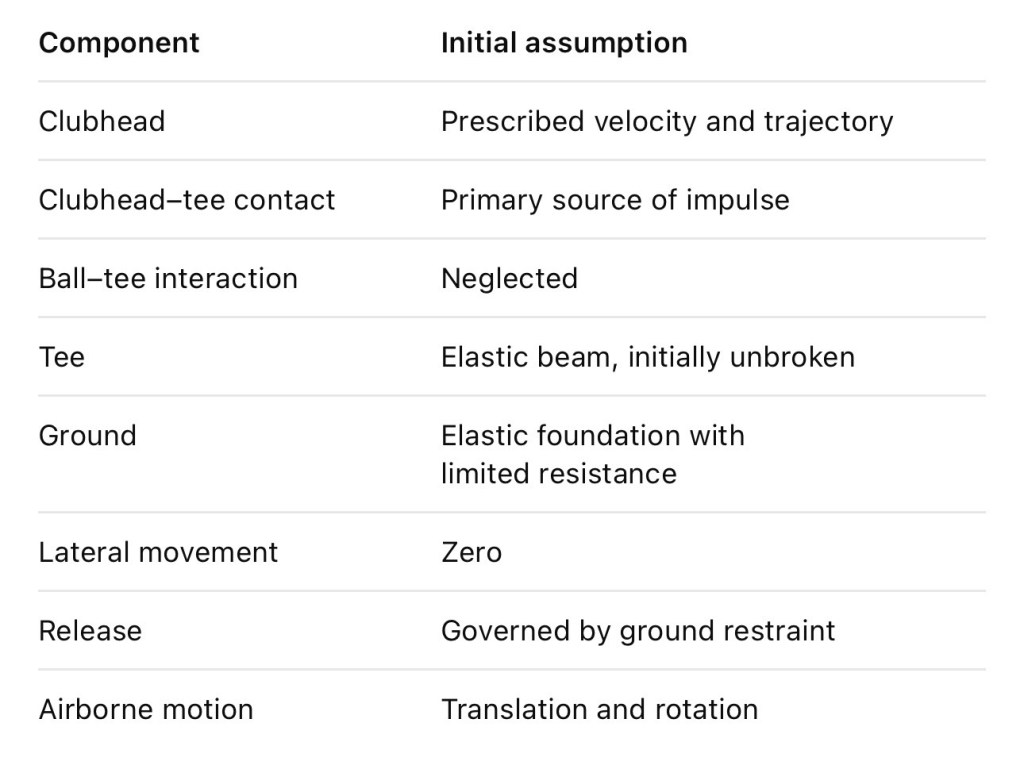
Each of those elements are tractable although the values of any parameters and constants are at present poorly defined.
Nevertheless this is a potential starting point for some mathematical modelling!
Hours of fun 😉🤷🏻♂️
If you found this post of interest please share it with others and subscribe to Craigavad golf
You may also be interested in Craigavad miscellany where I gently dive into mathematics, science, the natural world and other areas of interest.


