Hilary and I had a putting lesson a few weeks ago from Ryan Boal. Ryan is an an enthusiast and a great teaching professional. On a large and undulating green at LaManga he introduced us to the ideas underlying AimPoint and really opened our eyes to how it could help us read puts and improve our putting!
The AimPoint method for reading puts was invented by Mark Sweeney. Here he outlines the history and background of the method. This is a concise and clear overview of the method that mentions some of the criticisms of it (for example – being impolite, with poor etiquette and potentially slow).
For a golfer to “make” a put they must strike the ball cleanly with the putter, at the right pace (given the green speed and grass conditions), in the right initial direction such that any slope (or other grass condition such as grain) leads the ball to track inexorably to the hole where it falls with a delightful sound! Each element has to be in place and of course it is the case that there are potentially an entire family of curved paths on which the ball can track: faster pace on a shallow track or slower on a steeper track.
The central feature of AimPoint is the need to accurately assess the gradients and slopes over the entire path of the put but particularly in the later phases where the ball speed is dropping and the effect of slopes are amplified. This assessment is made by feel and the placing of the players feet astride and around the likely path of the ball. By this means the degree of the slope can be estimated. Now a one percent slope equates to a fall of one centimetre over a run of one metre; a two percent slope equates to a fall of two centimetres etc. So by using the nerve endings in the feet a player can build up a mental picture of the percentage slopes over the length of the intended put and particularly in the latter phase of the put where ball speed is falling.
With that mental model of the put the player can then use his fingers to make an assessment of where his start line might be. For a one percent slope the player holds up one finger with one side of the digit at the cup and the other side being the start point. For a four precent slope it is four fingers. All of this effort is intended to provide a reproducible means of determining an optimal start point (or aim point!) for the ball as it is putted.
Now the lesson Ryan gave us was great and it introduced as to the ideas. However . . . and this is the problem . . . as a healthy and neurologically intact 67 year old I found the assessment of the slopes with my feet very difficult. Yes, I could sense extreme slopes. Yes I could sense less extreme slopes and determine they were less than some slopes or more than others. However, when it came to the one percent and two percent slopes I just could not feel them with any reliability. Why might this be? Why can’t I sense the slopes that others clearly can how how will this impact AimPoint?
The essence of this issue is the concept of PROPRIOCEPTION. This little known part of the nervous system is the set of mechanisms the body uses to know the position in space of any body part. How to you know where your right hand is? Or left foot? Or left knee? Or right elbow? There are huge numbers of nerve endings (peripheral mechanoreceptors) of various types in our muscles, joints and skin that constantly feedback to the brain information about spatial issues. Consider the task of writing a letter using a pen. How tightly should you hold the pen? How much pressure do you use to push down on the paper? How do you know where the en nib is in space as ti passes over the paper? All of this is controlled and measured by proprioception.
But here is a key problem: proprioception deteriorates with age!
Features of major proprioceptive loss can be seen in some elderly individuals with balance issues and tendency to fall as well as some clumsiness. A range of neurological conditions may manifest in this way and of course drugs and alcohol can dramatically impact proprioception. But even in those without such extreme features small degrees of proprioceptive loss may occur with passing years. Age-related proprioceptive loss is really common!
Taking the published literature and trying to generate a n overview of the impact of ageing on the general population is not easy. Methodological issues abound and it is certainly the case that the amount and rate of proprioceptive decline is hugely variable. However utilising ChatGPT to summarise the published literature I generated this overview figure that provides a rough perspective on age-related proprioceptive loss. It should not be seen as an unimpeachable description of the real world but a crude model (an estimate) of age-relate change. It is a trend line about which there is considerable noise.
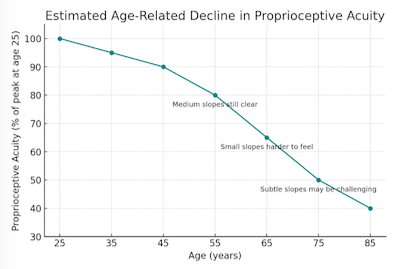
Considering this it may not be surprising that some “senior” golfers may find the AimPoint method of assessing slopes by feel quite challenging.
In no way a I decrying the AimPoint method. It clearly has many proponents who find it very effective. I simply posit that in some age-related proprioceptive loss may make it difficult to apply in at least some individuals. However visual queues may come to the rescue. In addition there may be ways to improve proprioceptive acumen. For example:
- Barefoot calibration and training might be a useful activity as it amplifies plantar feedback and allow calibration.
- Shoes and insole stiffness may have big effects. Low profile thin-soled showes may have a real place especially in practice.
- Standing with a wider base and loading both feet may be useful and using the balls of the feet may help.
- Hybrid cues especially with visual input is likely to be a major help
- Train with graded slopes and use a Clinometer (there are good smart phone apps for this) to facilitate perceptual calibration. Indeed there is published evidence that regular practice and training attentuates decline and may indeed reverse it!
Anyway, lessons from Ryan have convinced me that AimPoint has merit as part of my green reading. Personally I have not (yet) found the foot stradling approach helpful as a means of gauging minor slopes. Walking the green and using visual queues is crucial for me.
But maybe I need to get my shoes and socks off and start to retrain my nerve endings!

 Craigavad golf